
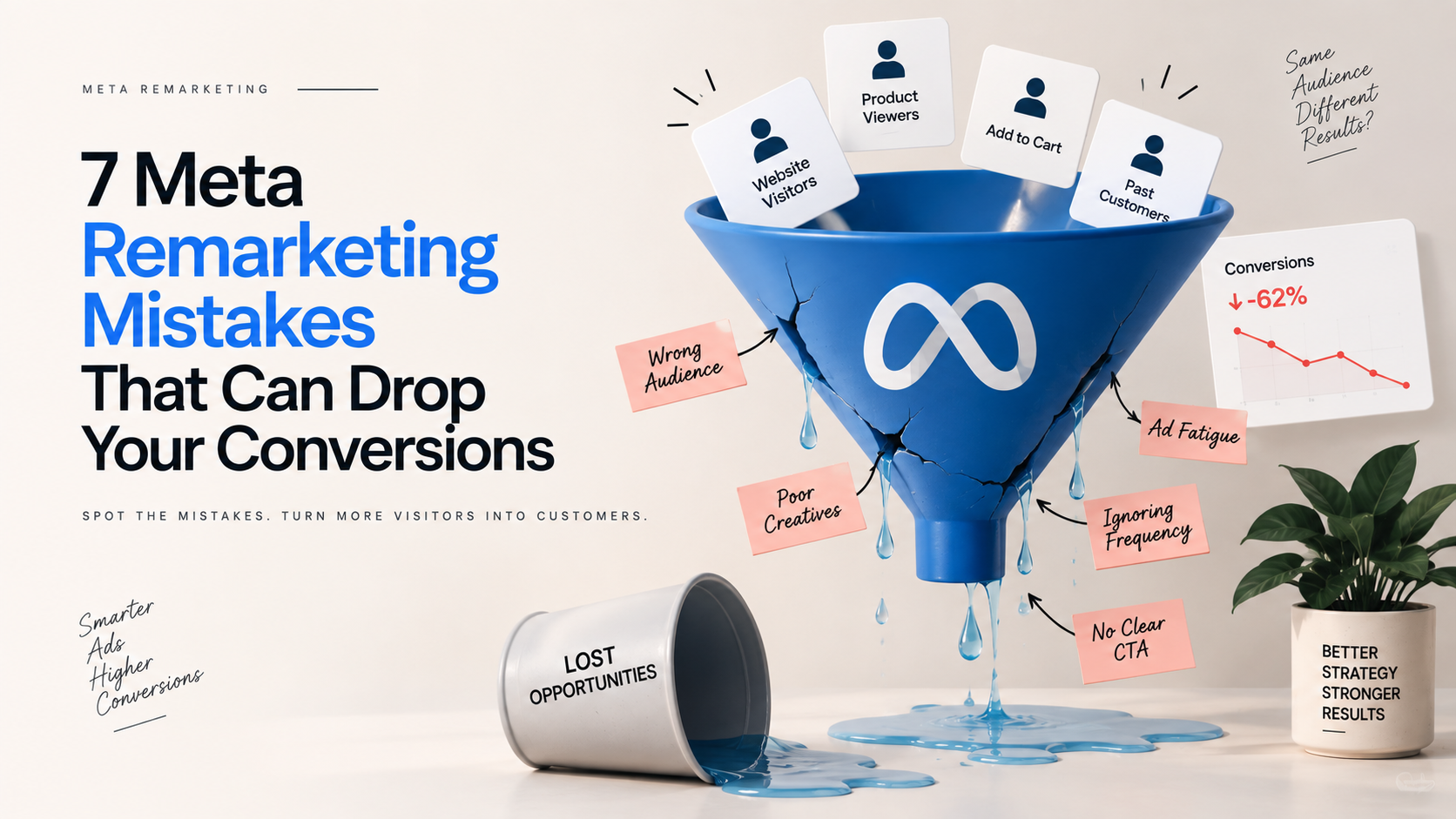
End up with disappointing results and sales conversions from Facebook and Instagram platforms? Frustrated with people repetitively visiting your site and checking out some products or services, but then leaving without making a purchase?
Doesn’t it sound familiar, like we used to do when buying something online? Well! Businesses running Meta remarketing campaigns should understand that not everyone will be prepared to act on their first visit to the site. But that doesn’t mean Meta retargeting ads aren’t worth it. Instead, website retargeting through Meta audiences is one of the most affordable ways of marketing.
However, just adding website visitors to a Meta remarketing list and showing them random ads might drastically drop your conversions. Without proper planning, an unlinked buyer’s journey and a random hit-and-try approach may also increase your budget for remarketing on Facebook Ads.
But how to fix that? Let’s go through seven common mistakes people used to make when running Meta retargeting advertising. The guide will not only help you increase conversions but also generate more qualified leads and sales at a reduced cost per click.
7 Common Meta Retargeting Ads Mistakes That Might Affect Your Conversions
There are several factors, such as the choice of audience, the type of content served, ad frequency, and click behaviour, that may highly impact conversions through Meta ads retargeting. Also, when personalised ads don’t match the actual needs of users, all efforts become useless. Thus, before investing more in Meta remarketing campaigns, ensure you are not repeating these mistakes.
1] Targeting the Wrong Remarketing Audience
Imagine 3 individuals: one who comes to your website once and leaves, another who goes through a product on your website and adds it to the cart, and finally someone who has purchased from you successfully.
These three have engaged with your brand and are part of your target audience with different intentions. Many remarketing campaigns treat them in a single category and serve them similar ads, which is a completely wrong process.
One who just visited you casually may need more information before coming to a decision; a cart abandoner may only require a reminder or the best offer to buy the product. The existing customer may be in search of some related products or have no reason to see ads about the product they have already bought.
Instead of creating the same ads for every visitor, you can use their action to make relevant ads; you can retarget product viewers with reminders, cart abandoners with offers and encouraging messages, and existing customers with some offers and new product launches.
2] Showing the Same Ad Again and Again (Ad Fatigue)
It is usual for one to look at the same advertisement twice or thrice; however, always looking at the same advertisement repeatedly may annoy your visitor. Ad fatigue occurs when an ad becomes irritating to the viewer and has an impact on your remarketing campaign.
When your engagement begins to decline with the same audience viewing your advertisement, you can quickly determine that you are experiencing ad fatigue. This doesn’t mean your ads are reaching the wrong audience.
You can try A/B testing with a few things, such as:
- Update the image: Choose a new photo/video.
- Change the content: Think of an alternative way to communicate your message.
- Try a new design: Change the whole ad format.
The idea of any social media advertising campaign retargeting must always be refreshing, and how people respond should determine whether it’s time to change the creative aspects again. Try to avoid similar promotions, which tend to bore the audience over time, and ensure fresh experiences with your remarketing ads.
3] Welcoming Everyone To The Same Landing Page
It’s great to get someone to click on your Meta remarketing ad, but that’s not it.
Let’s say they were looking at a particular product, clicked your ad to come back, and then ended up on the homepage. Now they would have to go hunting for that product all over again, and, frankly, a lot of people aren’t going to bother.
The same goes for any particular service or offer. In case you want to highlight some specific thing within the ad, then drive visitors to the dedicated page where they can get transparent details.
Make sure that the information is related to their search intent, and it should be easy for them to understand their next move. It is just like carrying on with a dialogue: the ad begins, and the landing page continues with the story.
If the ad and landing page are not consistent, then confusion may set in, and people will be lost in the process.
4] Retargeting Those Who Have Already Converted
Consider a customer who has bought something from you, who has completed the form, subscribed to your service, or anything of that sort.
What if the same person keeps getting the old promotional ads that they used to get before becoming a customer?
This occurs because of the failure to update the remarketing audience list after conversion.
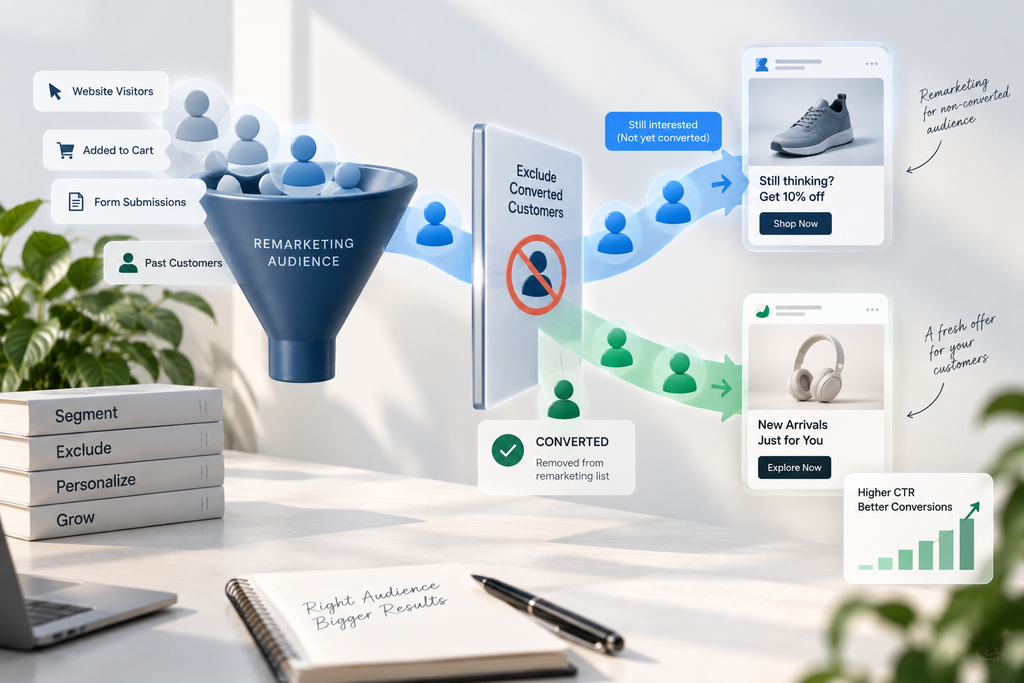
When a person has already converted, there is no need to spend remarketing budget to continue targeting them with the same ad. Instead, you should target them with a new advertisement, for example, a new product launch, a recurring offer, or a relevant service that may be of interest.
Moreover, once you have removed such customers from your old remarketing list, your retargeting advertising will only reach those people who have not yet converted. Thus, the customised retargeting ads will increase CTR, with better conversions.
5] Ignoring The Customer Journey
When someone visits your website, it means there’s something that caught their eye. But it does not really mean that they want to make purchases instantly. Maybe they are a potential customer exploring your brand, analysing your products, and making decisions.
Here is how a customer journey moves from first-time interaction to final purchase.
Stage 1 – Awareness – They get to notice your offerings after seeing the Facebook or Instagram ad.
Stage 2 – Consideration – They pay attention to your brand, compare, and search for more information matching their requirements.
Stage 3 – Intent Matched – They plan to buy the product or services from your site, but they need more evidence to make the decision.
Stage 4 – Conversion – After verifying everything like offerings, T&C, and more, they make the purchase.
Your remarketing strategy should go through these stages and create ads that slowly lead them from awareness to the conversion funnel. A question to ask yourself isn’t just, ‘Did they visit your website?’ It should be: ‘Which stage of the journey are they in?’
If you run the same website retargeting campaign for all customers visiting your website through Meta, your marketing message will become irrelevant to them. Thus, you must have strategies to structure different marketing campaigns to target a new audience, an interactive audience, and the people who are ready to purchase.
6] Sticking With Too Old Creatives And Ad Copies
You might be using a remarketing ad that currently works, but it won’t always work. It’s because people become familiar with the same ads, and after some time, they will no longer pay attention to them.
Thus, sticking with the use of the same creative or message is more likely to pull your campaign back. However, it’s not that hard to serve them with new ad sets. Just try these simple variations:
- Play with new visuals: use a different image or video.
- Change the message: test a new hook or way of explaining the offer.
- Switch the format: experiment if another ad format gets a better response.
- Change CTA: try different combinations of actionable words.
7] Focusing On Clicks Only Instead Of Conversions
Whether you are remarketing with Facebook Ads, YouTube retargeting, or managing Google Ads remarketing campaigns, you already know that people who have clicked on your advertisements have some level of interest in your brand.
However, just clicking an advertisement cannot tell you whether the retargeting ads campaign is actually working. For instance, one may end up clicking on the ad since he/she recognises the product seen before but does not end up purchasing anything or filling a conversion form.
Thus, the effectiveness of a remarketing campaign should not just be judged on the basis of the number of people who are coming back to your website, but also on the number of people converting into leads or making a real purchase.
Ask yourself:
- Did they fill out the form or contact you?
- Did the person return and complete the purchase?
- Is the campaign bringing actual revenue or quality leads?
- How much did you spend to get that conversion?
- Is the conversion rate satisfactory even after having a higher click cost?
What Should Be An Ideal Remarketing Approach?
Here is how a professional Meta advertising team practices to align the right messaging with the right audience list as per their buying stage to improve conversions through FB retargeting ads.
| Buyer’s Behaviour | What to serve via Meta remarketing ads | Buyer’s Psychology |
| Visited your website | A quick reminder of your brand | Understanding your brand |
| Viewed a product page | Show more products they were interested in | Taking interest |
| Checked a product/service page | Show them more details with relevant offers | Want to buy it |
| Added something to the cart | Encourage them to complete the purchase. | Looking for a great deal |
| Already purchased | Offer them a related or newly launched product | Looking for new deals. |
Takeaway – Ready To Get More From Your Meta Remarketing Campaigns
Using Meta for remarketing can be extremely efficient when it comes to reaching out to the people who have already shown their interest in your brand. But even small mistakes like repetitive ads, redirecting to incorrect pages, or audience list mismatch can impact the results. Thus, it is recommended to use effective strategies for your Meta retargeting advertising.
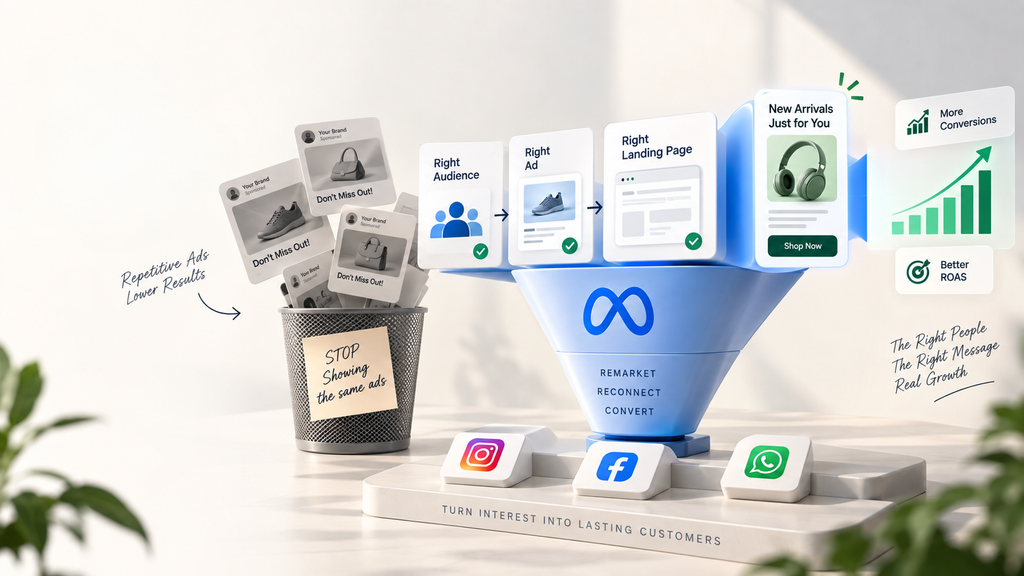
If needed, never hesitate to seek professional help to maximise your returns on Meta remarketing. Our team at Digital Narada, the best social media marketing agency, is here to offer you assistance. We can analyse your audience, ad copies, landing page setup, and campaign performance to build a tailored strategy for remarketing on Facebook Ads, Instagram ads, and even WhatsApp conversion.
Schedule a strategic call to scale your Meta retargeting advertising with Digital Narada.
FAQs
1] What is Meta remarketing?
Meta remarketing is a technique for advertising to those customers who have already shown interest in your company by visiting your website, considering a particular product, or engaging with your brand.
2] What are the common Meta remarketing mistakes businesses often make?
A few common mistakes with Meta remarketing include wrong target audience selection, displaying the same ad repeatedly, retargeting already converted users, and overlooking users’ customer journey.
3] Why does the customer journey matter in Meta remarketing?
Individuals who are just getting to know your brand would require a different message from those who have already shown a high level of interest. Thus, your Meta or FB retargeting ads must be personalised to serve people where they are on their buying journey.
4] Why is my Meta remarketing campaign getting clicks but no conversions?
Clicks indicate that people are taking an interest in visiting your site, but this does not really mean that actions will be taken. Make sure that the landing page connects to what the user expected to see after clicking your remarketing ad to improve conversions.
5] How to measure the success of a Meta remarketing campaign?
Whether you are running Facebook advertising retargeting, Instagram retargeting ads, or a WhatsApp remarketing campaign, having higher impression share, lower CPC, good CTR, and affordable conversion cost would be good to consider if your ads are performing well. Accordingly, you can plan a strategy to scale your performing Meta remarketing campaigns.