Key Highlights
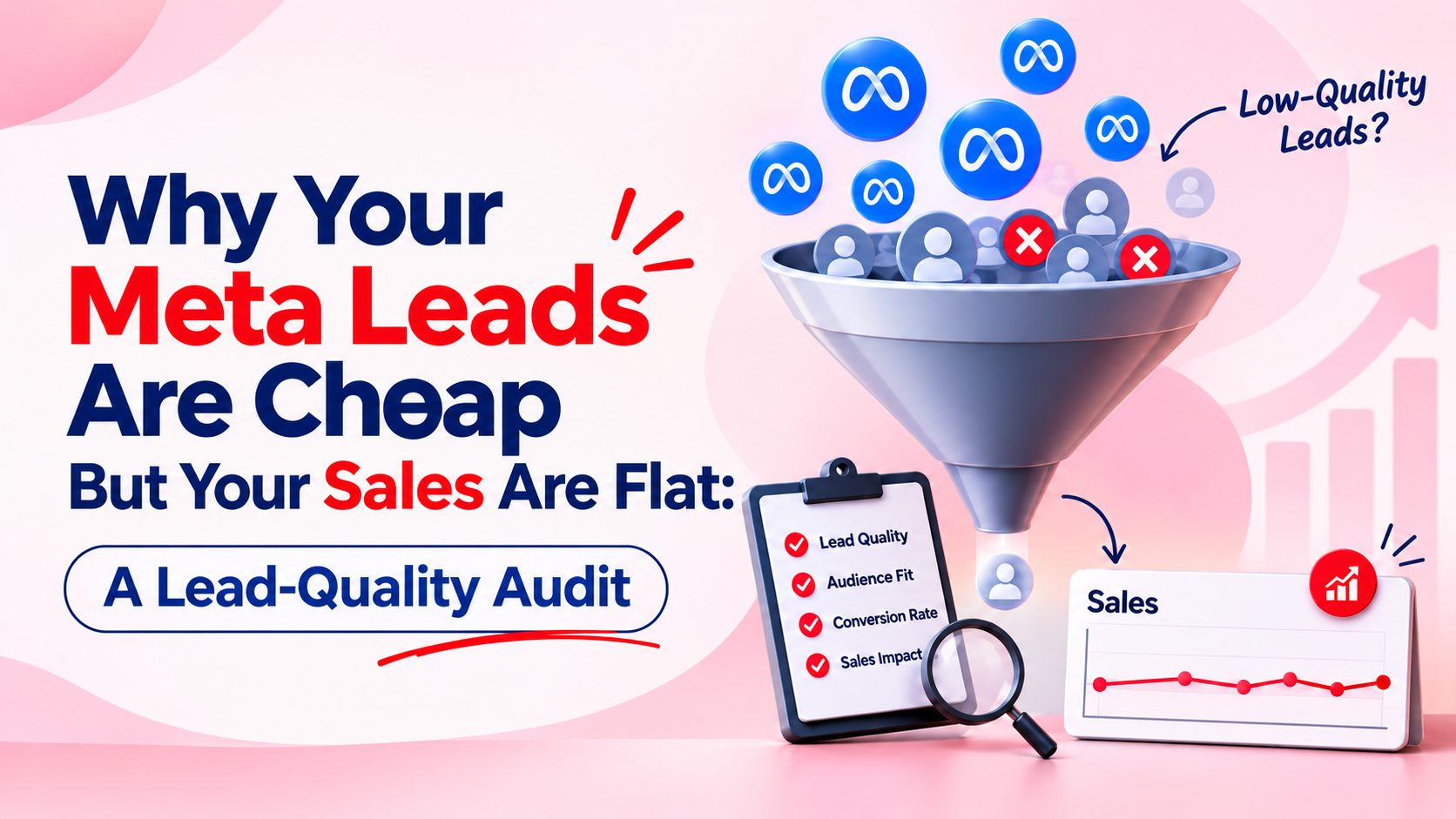
- A successful Meta campaign is not always indicated by a low cost per lead.
- Broad targeting, low-friction forms, or the wrong optimisation goal may provide cheap leads.
- A lead-quality scorecard can help in determining where prospects are dropping out of the funnel.
- Qualified leads, revenue, as well as opportunities are more meaningful than CPL alone.
- CRM data might assist Meta in understanding which leads are likely to become customers.
A few months back, an entrepreneur checked out their Meta Ads dashboard and smiled with relief. The cost per lead had gone down, and the campaign was now generating more leads.
Yet, when the sales team looked at their pipeline, it soon became evident that the enthusiasm did not last long because they discovered that the enquiries they had received did not respond or were not yet ready to purchase. They had more enquiries but no more sales. A good marketing effort might be indicated by low cost per lead; however, a vital issue- “poor lead quality”- might go unreported.
What Does A Low Cost Per Lead Actually Mean?
Cost per lead (CPL) indicates how much you are spending to generate a lead from Meta advertising platform. It does not indicate whether that lead is interested, qualified, or likely to purchase.
Let’s consider two campaigns for example,
| Metric | Campaign A | Campaign B |
| Leads generated | 200 | 80 |
| Qualified leads | 20 | 32 |
| Cost per lead | ₹ 300 | ₹ 700 |
| Sales opportunities | 5 | 12 |
| Customers | 2 | 7 |
The above table highlights that campaign A performs well if CPL is the only metric being considered. However, campaign B provides much more business value.
You can also use a simple formula to calculate your actual CPL.
Cost Per Lead Formula: Total cost invested on ads/ Number of total generated leads
E.g. ₹20,000 (Total ad spent) /200 (Total number of leads) = ₹100 (Cost per lead)
Why Are Your Meta Leads Cheap But Sales Flat?
1. Your targeting may be too broad
Meta will identify people who would complete the task you have set for them. Meta has an interest in finding people who will fill out the forms, in case you are running an advertising campaign that mainly seeks to generate leads.
However, filling out a form and buying something are two different actions altogether. Begin by comparing your ideal customers to your latest Meta leads. The similarities are found in:
- Location
- Job role or type of business
- Relevant demographics
- Purchase requirements
- Product or service interest
- Budget or commercial fit
- Buying timeline
- Previous engagement
2. Your lead form can be too easy to complete
Instant forms might lower friction and boost submissions if you haven’t enabled multi-factor authentication, email verification, WhatsApp approval, or OTP verification. However, if the prospect can fill out the form without thinking about it, you will get people who really don’t have any intention.
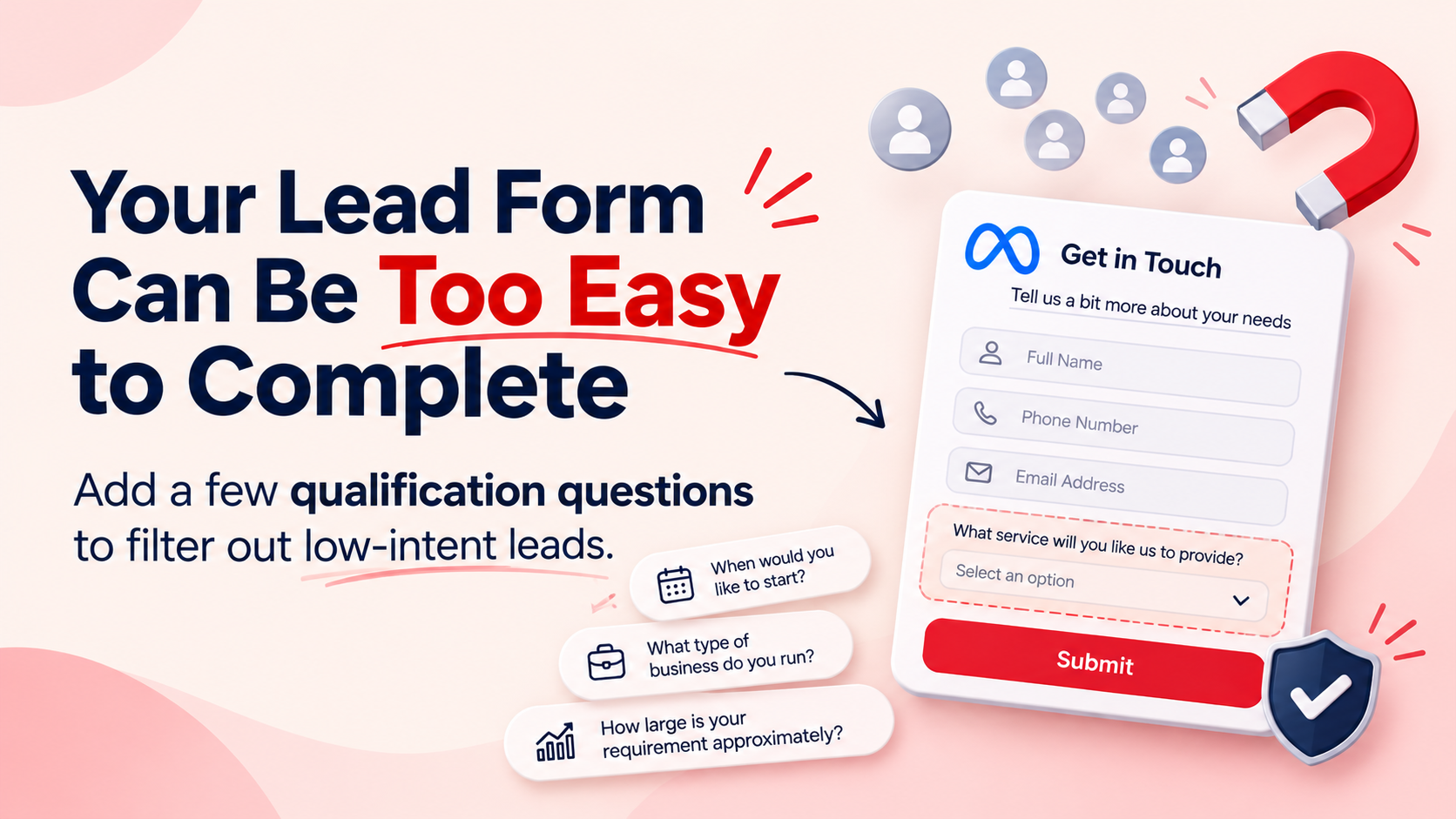
For instance, simply needing a name, contact number, and email address is likely to attract many individuals. Think about adding one or two useful qualification questions, such as:
- What service will you like us to provide you?
- When would you want to start?
- What type of business do you run?
- How large is your requirement approximately?
- Where would you like our service?
Meta’s lead generation guidance presents higher-intent forms and the use of qualifying details to upgrade the quality of leads.
3. Your advertisement might be attracting the wrong audience
Your ads generate an expectation even before the customer contacts your sales team. In case the creation makes an offer of something that is not true to reality regarding the product, pricing, process or eligibility, it will attract individuals who have an interest in the offer.
Your messaging must communicate,
- Who the offer is for
- The challenge it solves
- What the prospect gets
- Why the offer is relevant
- What happens after filling out the form
4. Meta might be optimising for volume instead of quality
This is the biggest area to explore during a Meta lead-quality audit. It becomes possible for Meta to identify who would be the probable respondents to fill in forms if Meta gets a notification whenever a respondent completes a form.
This is where CRM integration becomes important. The Conversion API for CRM from Meta enables companies to communicate relevant first-party CRM conversions to Meta.
5. The problem might be your sales follow-up
Sometimes a sales issue that arises later down the funnel is linked to the advertising effort. For example, imagine that there are 100 leads generated by Meta. When your sales team mainly manages to contact 60 of them, follow up with 30 of them, and qualify only 3, the lead generation process indicates a low conversion rate despite good-quality Meta leads.
Review certain things,
- Contact rate
- Average response time
- Appointment booking rate
- Frequency of follow-up
- Lead rejection reasons
- Opportunity rate
- Qualified lead rate
- Close rate
6. Use a lead-quality scorecard to identify the main issue
The lead-quality scorecard provides you with an easy way to assess the quality of leads coming from Meta rather than judging the campaign only by CPL. You may score each stage using your own CRM data along with sales feedback.
| Scorecard area | What to review | Healthy signal |
| Audience fit | Does the lead match your ideal customer? | High relevance |
| Intent | Is the prospect actively seeking the situation? | Clear requirement |
| Qualification | Does the lead fulfil your basic criteria? | Strong fit |
| Contactability | Can the sales team reach the prospect? | High contact rate |
| Engagement | Does the prospect respond to follow-ups? | Consistent engagement |
| Appointment | Did the prospect agree to the next stage? | Good booking rate |
| Opportunity | Does the enquiry become a genuine sales opportunity? | Strong progression |
| Revenue | Does the lead generate business? | Positive revenue contribution |
How to conduct a Meta lead-quality audit
A practical audit must examine the complete customer journey rather than one campaign metric. So, map your funnel something like this,
Ad → Click → Lead → Contacted → Qualified → Appointment → Opportunity → Customer → Revenue
After that, measure the conversion rate between each of the stages considering the following. You can also download a free Meta ads checklist for self review.
| Funnel stage | What to measure | What it can present |
| Ad | CTR and engagement | Creative or audience issues |
| Lead | Form completion and CPL | Acquisition efficiency |
| Contact | Contact lead rate | Lead accessibility |
| Qualification | Qualified lead rate | Audience and targeting quality |
| Appointment | Booking rate | Buying intent |
| Opportunity | Opportunity rate | Sales qualification |
| Customer | Close rate | Effectiveness of sales |
| Revenue | Revenue per lead | Actual business value |
What should you optimise first in a Meta Ads campaign?
If your leads from Facebook or Instagram ads are inexpensive yet you are making no sales, do not be tempted to start expanding your budget right away. Go through the funnel systematically:
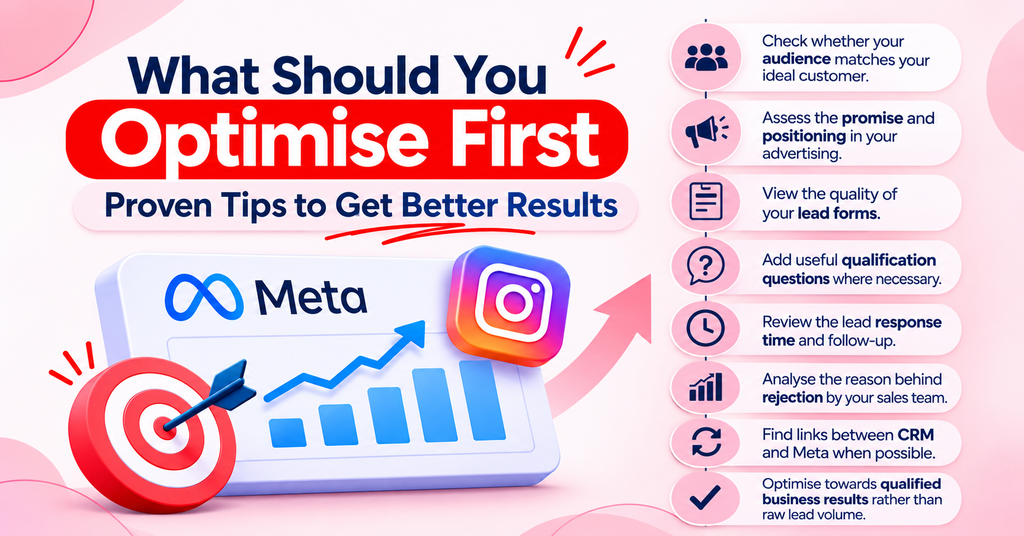
- Check whether your audience matches your ideal customer.
- Assess the promise and positioning in your advertising.
- View the quality of your lead forms.
- Add useful qualification questions where necessary.
- Review the lead response time and follow-up.
- Analyse the reason behind rejection by your sales team.
- Find links between CRM and Meta when possible.
- Optimise towards qualified business results rather than raw lead volume.
Digital Narada is a performance-driven digital marketing agency powered by marketing intelligence. We view Meta performance marketing through a lens of quantifiable business consequences instead of concentrating just on impressions, clicks, or lead volume. You may look at our LinkedIn Ads conversion guide and Meta Ads lead-generation method for a comparable conversion-focused strategy.
Verdict – Turn Average Lead Quality Into Measurable Growth
Lowering the cost-per-lead looks very appealing to see on a Meta Ads dashboard. However, if these leads don’t convert into quality leads and customers for your company, reducing your CPL alone will not bring benefits.
If your campaigns on Meta are giving you lots of leads, but your sales funnel does not see any growth, you must consult an experienced Meta Ads agency. You can contact our specialist at Digital Narada who will help you find the gap and create a scalable Meta ads strategy based on qualified leads and conversions.
FAQs
Why are my Meta leads cheap?
Cheap Meta leads may occur due to wide targeting, frictionless forms, cheap placements, or campaigns optimised only for volume of leads. Cheap CPL does not always mean high buying intent.
How do I increase Meta lead quality?
Check out your targeting, creative, offer, and lead form. Add appropriate qualifying questions, find out why leads get rejected by sales and try to connect it with your advertising results.
Do I concentrate on CPL or quality leads?
Quality leads can be more helpful for measuring the performance of the business. The CPL shows the price per submission, and quality lead metrics help us understand if the submissions are commercially viable.
Can CRM data help qualify Meta leads?
CRM data gives Meta information on what happens once the lead is created. The Conversions API for CRM from Meta was designed to help advertisers optimise with these downstream events in mind.
What is the reason behind many leads captured, yet few sales?
The problem could happen at various stages such as targeting, qualification, follow-up, and the execution or sales process. The audit of the funnel will pinpoint where the highest drop-off is happening.
How can Digital Narada help with Meta Ads management to scale performance and sales?
Digital Narada has a strong core expertise in Meta Ads management that includes Facebook Ads, Instagram Ads, and WhatsApp ads. We have generated proven results for clients dealing in B2Bs. You can explore our Meta PPC ads management portfolio here.