
You run a LinkedIn Ads campaign, you get impressions rolling in, and you build up good engagement with click-throughs. However, if you take a look at the number of leads or demo requests, the numbers come up short. Sound familiar?
It is not necessary that you have a successful campaign with many clicks. Increasing conversion rate involves the conversion path, audience targeting, your offers, and regular observation. All these factors play a key role in conversion optimisation that leads to tangible campaign outcomes.
What Is the LinkedIn Ads Conversion Rate?
A LinkedIn conversion rate is the ratio between the ad viewers and the desired action taken by them on the ad. It may be a lead form, downloading a resource, webinar sign-up, or trial sign-up.
If, for instance, you have the situation that 1,000 individuals clicked your ad and among them 50 performed the requested action, then the corresponding conversion rate of that campaign would be 5%.
But conversion rate shouldn’t be considered alone. If your campaign generates many leads, it may seem successful. However, if those leads don’t become customers, the campaign may lack business value. Fewer qualified leads could deliver better results. Read more if LinkedIn ads can give a good lead conversion in our insightful comparison guide.
How to Identify What’s Not Working In Your LinkedIn Ads
| What you see | Possible issue | What to check |
| Low CTR | Weak message | Headline and creative |
| High CTR, low conversions | Post-click issue | Offer and landing page |
| High form completion, poor leads | Weak targeting | Audience criteria |
| High CPL | Poor targeting or weak offer | Audience and offer |
| Good leads, low sales | Follow-up gap | Nurturing and sales process |
This method enables you to make the optimum changes based on your evidence, rather than making several changes and not knowing what has changed that has actually affected performance.
7 Useful Ways to Improve Your Conversion Rate
Now, let’s see the 7 most efficient ways to improve your LinkedIn Ads conversion rate and get the most from this platform within your budget. Meanwhile, if you are a newbie, read this guide of how to use LinkedIn ads for ABM to start from scratch.
1] Improve Your Audience Targeting
No matter how well you have curated the ad copy, if an ad is shown to the wrong audience, then it won’t drive conversions.
Things like job title, industry, company size, seniority, and location are all professional traits B2B marketers can use to target in LinkedIn ads. When creating your audience around your ideal customer profile, you can use these options to your advantage by not targeting everyone who could use your product.
Start by identifying:
- Relevant industries
- The job functions and seniority of the staff members will be taken into account.
- The size and location of the company.
- Individual accounts or account groups
- The issues your audience has to solve
Don’t cast your net so wide to get impressions that you’ll be attracting the wrong people. Instead, make targeted segments and contrast their conversion rates. It is also wise to choose an experienced LinkedIn lead generation agency to make a solid ABM marketing foundation.
2] Use The Business Logic Behind The Offer
Requesting too much, too soon, from prospects is a prevalent LinkedIn Ads mistake.
If you find a new client for the first time, there’s a chance he or she isn’t ready to schedule a sales appointment. Rather, match their offer with the buyer’s stage.
| Buyer stage | Suitable offer |
| Awareness | Guide, report or research |
| Consideration | Case study, webinar or comparison |
| Evaluation | Demo or consultation |
| High intent | Free trial, quote or sales call |
The more the offer is in sync with what the prospect needs at the moment, the better the reason to convert.
3] Create Ads That Have A Clear Message
Your LinkedIn ad has a limited timeframe to leave an impression. When the CTA, visual, and headline text convey conflicting impressions, viewers might be left wondering what to do next.
Every ad must address an issue, present a corresponding value, and include a directive.
Instead of saying: Make a change in your digital operations with our technology solutions.’
Try: “Minimize manual reporting by utilizing dashboards that are automated for marketing.”
The second message is more specific and provides the audience with a reason to listen.
LinkedIn’s research shows that nearly a majority (49%) of those B2B decision makers questioned would have shown a higher level of interest. Ad creatives would have surely led to appropriate action from them.
The use of different formats and visuals, as well as the type of call-to-action, to figure out what captures your audience’s attention is a way to do that.
4] Simplify The Setup Of LinkedIn Lead Gen Forms
Conversions will decrease if you ask the user to go through multiple steps before they agree to give you their information.
Unlike other PPC lead generation forms, LinkedIn lead generation forms leverage professional data already provided on a member’s profile to enable them to enter information without having to fill in each field.
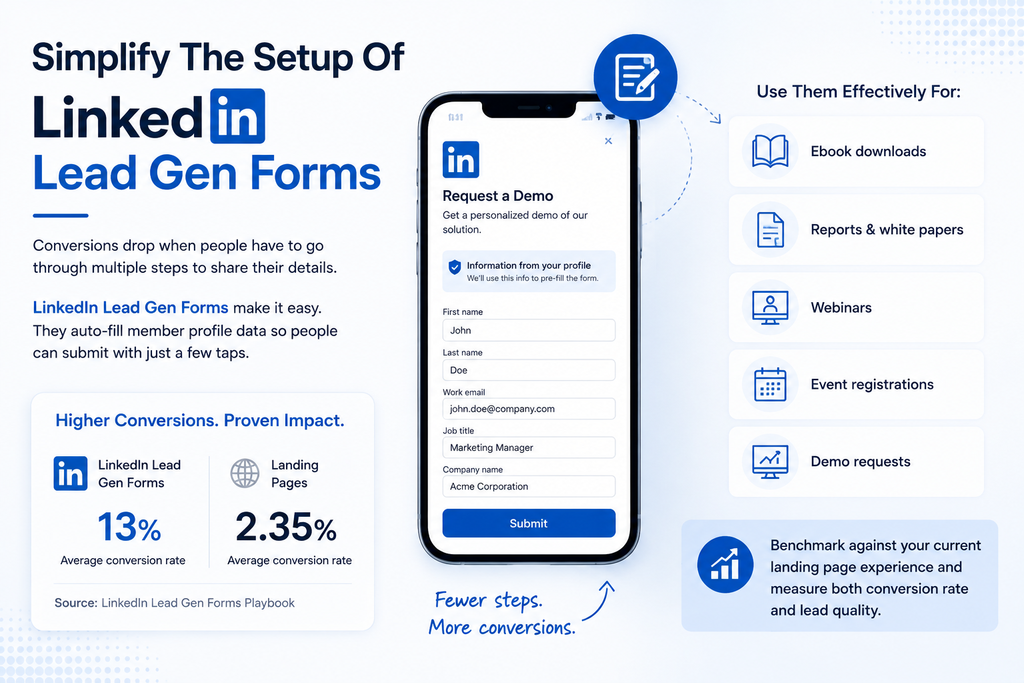
They can be used very effectively with:
- Ebook downloads
- Reports and white papers
- Webinars
- Event registrations
- Demo requests
According to data in LinkedIn’s Lead Gen Forms Playbook, LinkedIn Lead Gen Forms have a 13% average conversion rate, while data from landing pages show that rate to be 2.35%.
This is not a standard you must meet across the board, so compare Lead Gen Forms to your current landing page experience and measure conversion rate and lead quality.
5] Make Your Landing Page Match The Ad Copy
If you click on a marketing report that promises to be free and find yourself on a generic home page, what does that mean? You now have to search for the promised resource. That additional friction could be fatal to the conversion.
Your landing page should be a perfect echo and explanation of that one message the advert has first put into light. Even the main title, the promotion, the secondary information, and the final instruction should all be like an unfinished Linked In Advert.
Keep your visitors interested in one primary activity by removing all unnecessary elements that can cause distraction.
Stand-alone landing pages focused on the campaign offer are recommended by LinkedIn, and suggest having lead generation forms as short as possible, ideally to five fields.
6] Make Sure To Monitor Conversions, Not Just Clicks
A campaign manager may run a campaign that generates a high CTR to represent success. The issue appears when those website visits aren’t resulting in good clients or business revenue. In this case, we must do something about it.
Monitor parameters like the following:
- Conversion rate
- Cost per conversion
- Cost per lead
- Lead volume
- Lead quality
- Demo or trial registrations
- Pipeline generated
With the aid of LinkedIn conversion tracking, marketers get access to monitor different conversion goals, including lead submissions, content downloads, sign-ups for free trials, purchases, registration for events, or any other type of interaction.
Marketing Analytics comes into play here. It is the one that will help companies decide which campaigns contributed the most to positive results.
7] Do Testing, Learning, And Then Reallocate Your Budget
Usually, there is a range of parameters to consider to get the most from LinkedIn ads, and the prime one is structured testing that provides better performance.
Consider testing the following variables:
- Headline
- Creative
- CTA
- Audience
- Offer
- Landing page
- Lead Gen Form
Experiment with one major variable at a time to determine what caused the difference in performance.
If one of the ads is lower cost per qualified lead, then see if you can take some elements of the creative or messaging and test again.
Avoid targeting the lowest conversion. Assess the leads against your ideal customer and progress in the sales funnel.
Verdict – Make LinkedIn Ads Your Measurable Business Growth
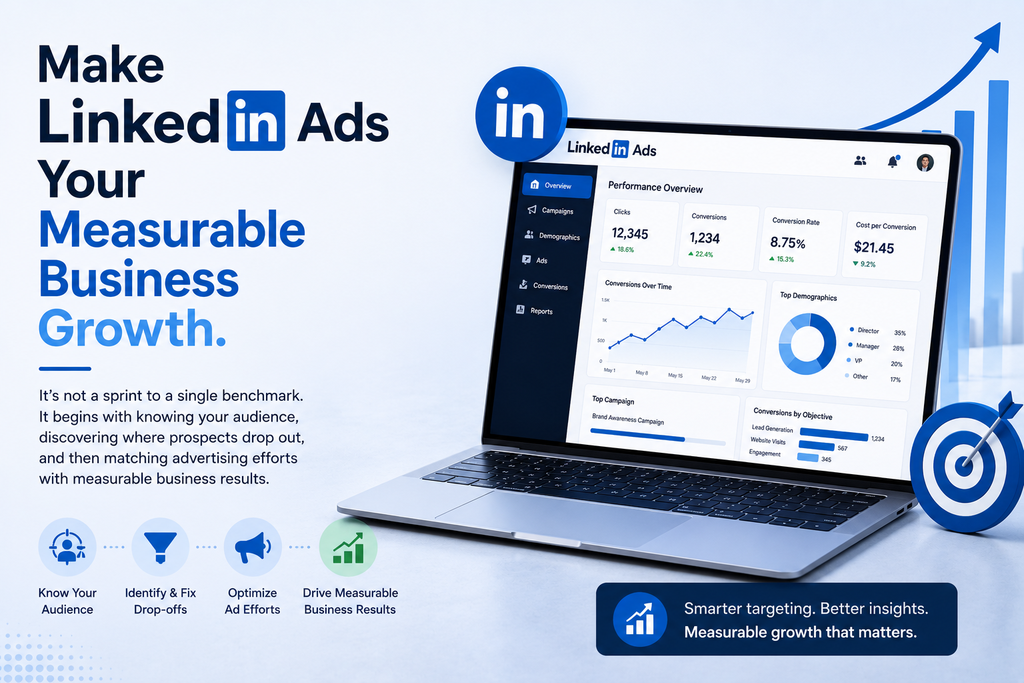
It’s not a sprint to a single benchmark that should be the goal of improving the LinkedIn Ads conversion rate. It begins with knowing your audience and discovering where prospects drop out, and then matching advertising efforts with measurable business results.
Digital Narada is a leading digital marketing firm that follows a Marketing Intelligence approach to help businesses generate quality leads, as it considers several factors, including customer psychology, demographics, and more, to give the best results.
When LinkedIn campaigns are driving clicks but not ROI, a data-driven marketing audit can help you understand where you’re missing the target, where you are going astray in your message, and where you are falling short in the conversion process.
Find out how Digital Narada can help you make LinkedIn marketing investments count.
FAQs
1] What should be the conversion rate for LinkedIn Ads?
There isn’t a right or wrong standard. Performance is influenced by industry, audience, offer, campaign goal, and funnel stage. Compare against historical results and lead quality.
2] Why is my LinkedIn ad not converting?
The customers most likely ignore the CTA, as your layout is not good enough or the content you use does not match your audience’s needs. Therefore, it is not motivating them to take that desired action.
3] Are lead gen forms better than a landing page for generating leads?
They can minimize friction due to profile information being pre-filled. But businesses should do both and also think about their conversion rate and the quality of leads.
4] What is the best way to lower the price of LinkedIn Ads per lead?
Enhance the appeal of your LinkedIn advertising and emphasize your main selling points. Also, utilize fresh ad ideas so that users take the desired actions and reallocate budget to those quality lead ads.
5] What are the KPIs to track for LinkedIn ads?
Check conversion rate, cost per conversion, CPL, and other important downstream business metrics. CTR and impressions are good indicators, but do not rely on them as your only success metrics.
6] How many times should I check LinkedIn Ads?
Testing should be continuous. Allow for enough data to determine meaningful patterns. Only test one variable at a time.