Imagine you have been running B2B ads for months; you are spending money, but the results simply do not seem right. You are getting clicks, some leads, and good metrics, but leads are not actually converting into a real business. The problem may not necessarily be your ad budget or the platform you are using for advertising.
The real issue can be your ads reaching the wrong B2B audience or wrong targeting.An ICP (ideal customer profile) works well here if you know exactly which businesses and decision-makers you need to reach. With this knowledge, you are more likely to create more focused ads, attract potential leads, and allocate your budget wisely. This is not about clicks but about generating revenue from the right traffic through B2B ad campaign optimization and return on investment (ROI).
Why ICP Matters in B2B Advertising
An ideal customer profile (ICP) is a clear definition of the kind of business or company that will most probably need your product or service and will be a potential target customer for a firm. It tells you exactly whom you should target when placing your B2B advertisements.
Having a clear target goal helps you turn that information into the right audience targeting, messaging, and ad-building strategy. With the right audience identification, you could run your B2B ad campaign, generating a good return.
Ways to Optimize Your B2B Ads Campaign to Improve Results
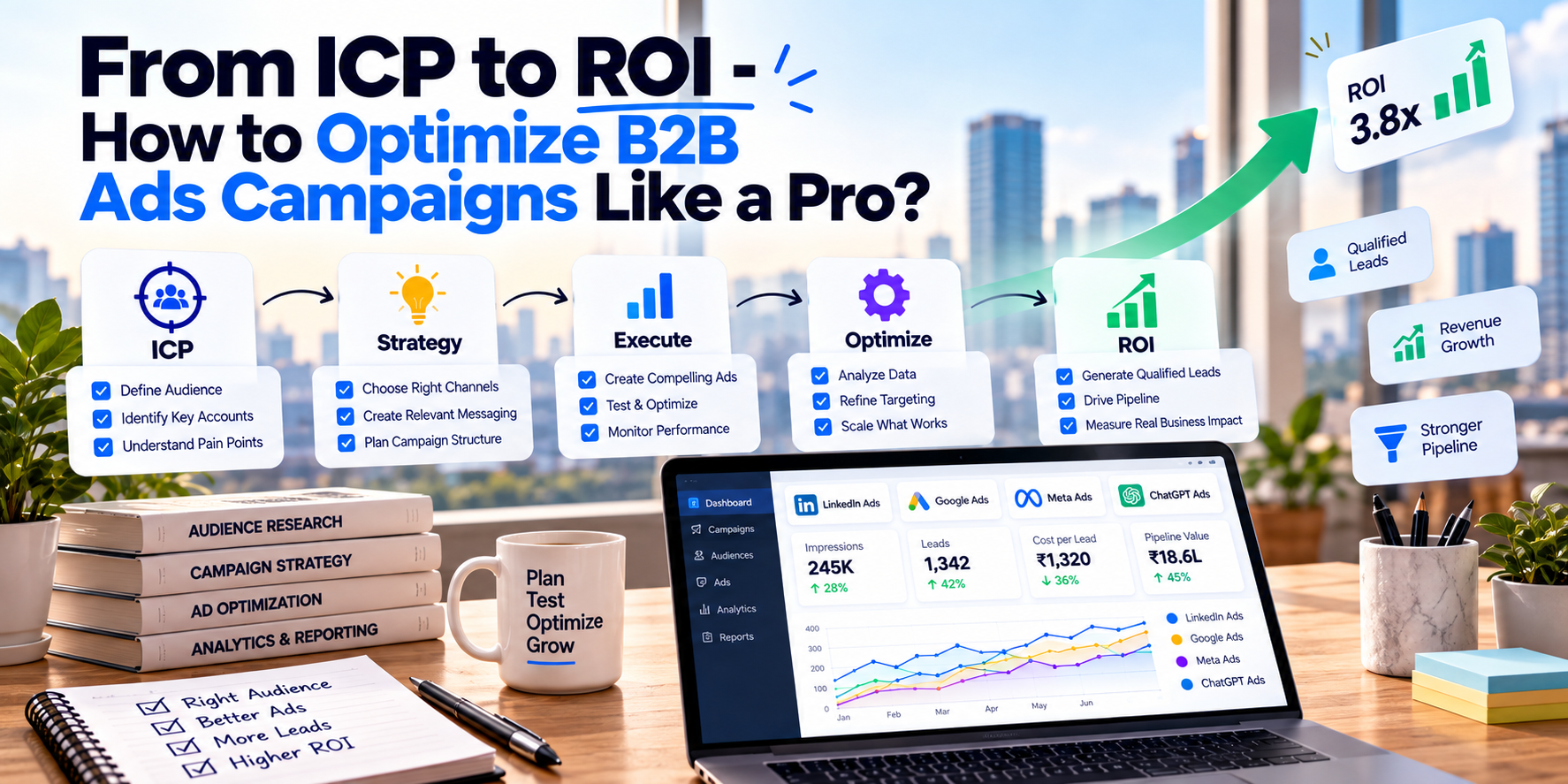
1. Define Your ICP Before Spending on Your B2B Ads
Before spending ad budget on Facebook, LinkedIn, Google, or other B2B advertising platforms, it is important that you know who the targeted businesses are. Define your ideal customer profile to identify a target market audience and avoid unnecessary ad spend.
To identify your target market, you must check:
- Industry
- Company size
- Decision makers
- Location
- Revenue
LinkedIn B2B Ads can be used to reach professionals and businesses based on these factors.
2. Match Your Ad Copy With Buying Intent
When you know who your perfect customer is, the next thing is to know what they want and how prepared they are for the purchase. Some people may still be exploring, and some might be searching. It is important for you to know the funnel stage of your ideal customer instead of spending your budget showing the same ads to everyone.
Buying intent helps you understand how interested the potential customer is in the sales or services. Someone who searches for a specific product shows greater purchase intent than someone who is just reading an industry article or scrolling past an ad.
Similarly, a person who has already visited your pricing or product pages may be more interested than some person who has rarely seen one of your social media posts. These signals will help to identify what type of audience requires awareness content, who needs an offer, and who is already focused on sales.
3. Optimise Ads Based On Target Interest
Your ads may be reaching the right audience, but the messaging may not be addressing what the ICP is actually looking for. Look for pain points, goals, and priorities of your ICP and make use of these data to optimize your ad messaging.
For example, if your target businesses wish to minimize their marketing expenses, the advertisement must highlight the cost savings and results of the service rather than just promoting your digital marketing services.
You can try out different headlines, ad copies, creatives, offers, and CTAs to check out which version brings you potential leads. Use the version that works better for you and optimize those that bring you clicks but do not give ROI. This helps you continuously improve your ads based on your ICP and move closer to better conversions and ROI. You should also focus on a cross-platform remarketing strategy to better optimize budget and ad serving.
4. Stop Optimizing for Clicks and Start Tracking ROI
With clicks and impressions, you can get to know if your ads are being noticed, but they do not tell whether you are getting enough value from your ad spend. Clicks and impressions can show that people are noticing your ads, but they do not tell you whether you are getting enough value from your ad spend.
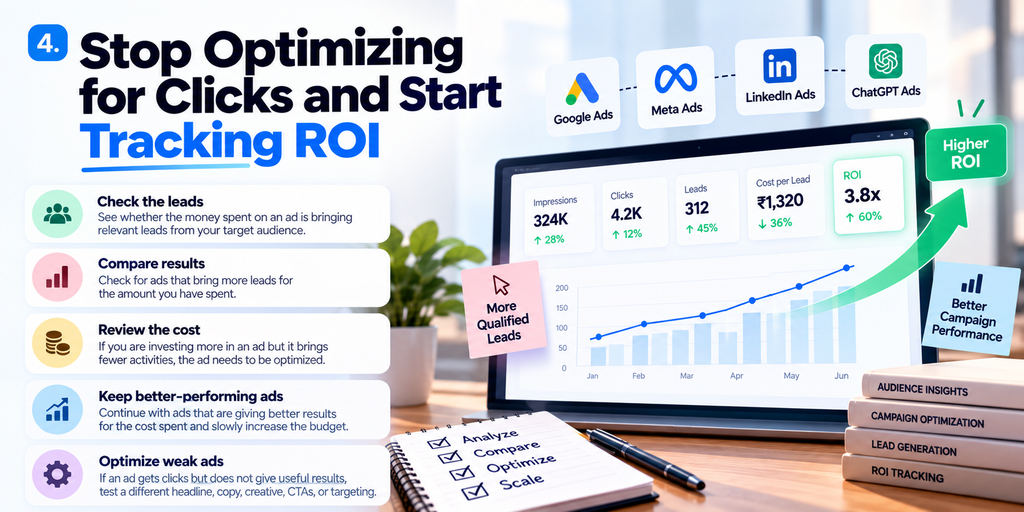
For B2B ads, the main focus should be on whether the money spent on advertising is bringing useful leads, inquiries, and customers. By comparing the cost of different ads with the results they generate, you can understand which ads are giving better returns and where your budget needs to be improved.
- Check the leads: See whether the money spent on an ad is bringing relevant leads from your target audience.
- Compare results: Check for ads that bring more leads for the amount you have spent.
- Review the cost: If you are investing more in an ad but it brings fewer activities, the ad needs to be optimized.
- Keep better-performing ads: continue with ads that are giving better results for the cost spent and slowly increase the budget.
- Optimize weak ads: if an ad gets clicks but does not give useful results, test a different headline, copy, creative, CTAs, or targeting.
5. Link Ad Data With Your CRM
Connecting the ad data with the CRM allows you to track actions such as lead clicks on your ad or form fills. You will be able to trace the source of the lead and whether the lead fits the ICP and their interest in your offering.
This gives you a clear understanding of which ads are bringing the right audience and which ones are helping generate actual customers.
The information collected by your CRM may then be used to optimize your advertising campaigns and help you use your ad budget carefully and move towards better ROI. With a CRM, you will be able to focus on the audience and ads that attract more clients. If an ad is getting more clicks but fewer leads, try optimizing targeting or ad messaging.
6. Optimize Your Ad Budget
B2B ad budget optimization will help you avoid excessive spending on ads that do not bring any useful results. Rather than using the budget equally across all campaigns, measure the performance of each ad and see which ads are bringing you the right target audience, better lead generation, and target clients.
Invest more in the successful campaigns while reviewing the unsuccessful ones. Having a targeting based on your ideal customer profile helps you make better decisions about your budget allocation.
- Avoid broad targeting: instead of showing your ads to everyone, keep your targeting close to ICP by focusing on the right industry, company size, location, or decision-makers.
- Campaigns with return: Analyze all of your marketing activities to identify those campaigns that have generated returns on investment. Give priority to those campaigns that regularly bring you clients or leads.
- Reduce spend on weak ads: If your ad is getting clicks but is failing to turn leads into sales, you must optimize targeting, message, ad creative, or the offer before increasing its ad spend.
- Test before increasing budget: When your ad campaign starts doing well, try to test with a small budget increase and check the results; it will help you with further budget allocation. Go bit by bit; don’t spend a large amount based on short-term performance.
5 Costly Mistakes That Can Affect Your B2B Ad Performance
Even after setting up a campaign correctly, some optimization mistakes can affect its performance. While doing B2B ad campaign optimization, avoid making quick changes and analyzing your results from limited data. Instead, a better approach is to make slow changes by comparing the results and providing enough time to show their impact. Below are some B2B campaign optimization mistakes that can affect your performance.
- Making changes without enough data: Give your marketing campaign enough time to collect data before changing the target market and audience.
- Changing too many things at once: Don’t make changes to your target market audience, ad copy, ad creatives, and budget at one go. Make slow changes to identify their impact on performance.
- Discontinuing ads too quickly: An ad may not work successfully at the beginning but can improve with additional data. Before deciding to discontinue it, check its performance with other ads to identify any visible reasons for poor performance.
- Not comparing performance over time: Compare the current results with your previous campaigns to understand whether your B2B ads campaign optimization is actually showing improvements, or it is just short-term changes.
- Optimising for the wrong goal: Avoid B2B campaign optimization based on a single metric. Review the outcome of your campaign against your actual goal and take action that will improve the performance and return on investment (ROI).
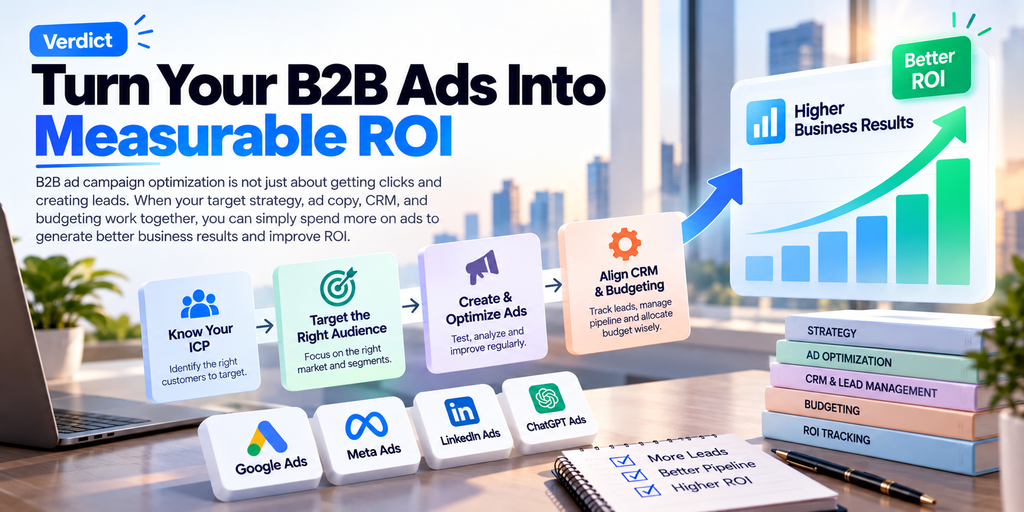
Verdict- Turn Your B2B Ads Into Measurable ROI
B2B ad campaign optimization is not just about getting clicks and creating leads. It begins with you knowing your ideal customer profile, the right target market and audience, and B2B campaign optimization by regularly improving the ads based on the metrics of their performance.
When your target marketing strategies, ad copy, CRM, and budgeting work together, you can simply spend more on ads to generate better business results and improve ROI.
To get your B2B advertising campaigns to reach their full potential or increase your return on investment (ROI), connect with the experts at Digital Narada to explore the right approaches for your campaigns.
FAQs
1. How does ICP help in B2B ad campaign optimization?
A clearly defined ICP helps you to target companies that are more likely to need your sales or services. It also allows you to optimize audience targeting and spend your ad budget more effectively.
2. How can I optimize my B2B advertising campaigns for better ROI?
Review your targeting, ad messaging, leads, conversions, and budget regularly, and focus more on the campaigns that bring relevant leads and better business results instead of optimizing only for clicks.
3. What should I track to measure B2B ad ROI?
Review your expenses and your ROI, while considering leads, enquiries, conversions, and clients, to understand whether your ads are actually contributing to your business. Compare the performance of your previous campaigns and make adjustments where needed.