2026 and the years beyond are supposed to be years of marketing efficiency, AI edge, and smart brand positioning. On one side, where marketing budgets are under pressure for many businesses, AI is bringing opportunities to automate marketing work, consumers are looking for affordable deals, and CMOs are under pressure to prove business ROI. Still in this chaos, Nestlé, a well-known food and chocolate brand, is doing something different to increase its awareness campaigns while securing its sales margins.
Looking at the numbers, we can see that Nestlé has raised its advertising and marketing costs to 8.9% of sales in H1 2026 compared to 8.6% in H1 2025. They are also able to raise their organic growth to 3.6%, real internal growth to 1.5%, and growth in the e-commerce business to 12.2%.
But how is Nestlé able to do that? Why did they decide to invest more in marketing campaigns even while under pressure to secure their margin?
Well! In this Nestle marketing case study, we will get all the insights along with their strategic marketing plan, how they are utilising AI and automation, and innovative approaches that help them thrive in the competitive market. It will help you strategise your online marketing and advertising while taking care of fast-moving stocks and your stakeholders and following the right practices to balance between margin and branding.
The Numbers Behind Nestlé’s Marketing Increase
Nestlé’s H1 2026 result clears that the company spent slightly more on marketing even when some financial numbers have actually moved down. The table below shows that sales and underlying operating profit declined, but organic growth and RIG still improved.
| Metric | H1 2025 | H1 2026 | Change |
| Sales | CHF 44.23B | CHF 43.11B | -2.5% reported |
| Organic growth | 2.90% | 3.60% | +0.7 pp |
| RIG | 0.20% | 1.50% | +1.3 pp |
| Advertising & marketing/sales | 8.60% | 8.90% | +0.3 pp |
| Underlying operating profit | CHF 7.29B | CHF 7.08B | -2.80% |
| Operating margin | 16.50% | 16.40% | -0.1 pp |
| E-commerce growth | – | 12.20% | – |
Based on Nestlé’s reported sales and the marketing metrics, the estimated advertising and marketing spend increased from about CHF 3.81 billion in H1 2025 to CHF 3.84 billion in H1 2026. Therefore, even though there were fewer sales reported, the marketing budget increased by around CHF 30 – 35 million per year.
However, Nestlé is not simply spending more everywhere; they say they are putting more into fewer, bigger, and more important activities for core brands. The main lesson is simple: good marketing is not only a matter of increasing budget; it is a matter of spending the budget in the right place.
Nestlé Is Not Increasing Marketing Blindly – Instead Following a Smart Approach
Nestlé’s decision to increase the marketing spend does not mean the company has stopped worrying about its costs. The company is also working on its fuel for growth programme at the same time to cut unnecessary costs and make the business more efficient.
- Just like at the end of H1 2026, there was a total saving from the program that amounted to CHF 1.7 billion, including CHF 0.6 billion in savings at H1 2026.
- The objective of the company is to ensure that the total savings reach CHF 2.0 billion at the end of 2026 and CHF 3 billion at the end of 2027.
- This data shows that it is not that Nestlé does not care about the cost. This is an effort by Nestlé to cut costs in its operations while at the same time safeguarding its investments for future growth.
- Marketing is one of the important areas because it helps Nestlé keep its brand visible and create demand.
The whole idea behind Nestlé’s strategy is to cut costs that do not create demand but protect investments that help create demand.
Reason 1 – Nestlé Needs Volume Growth, Not Just Price Increases
The first reason Nestlé is protecting its marketing investment is the need for growth, besides the price increase. FMCG companies have been relying heavily on prices to offset the effects of inflation, but prices can only be increased to a limit. The results for Nestlé H1 2026 clearly show this shift.
- Nestlé grew organically by 3.6% in H1 2026, 2.1% due to pricing and 1.5% because of RIG.
- For H1 2025, the organic growth was 2.9%; of this, pricing contributed 2.7%, and RIG was just 0.2%.
This means that despite the fact that Nestlé’s sales performance depends heavily on price, the volume/mix effect is getting stronger.
This is an important difference, as in 2025 Nestlé’s growth was mainly price-led, while in 2026, the company is seeing more growth from RIG. It shows a move towards more consumption-led growth.
Here, advertising plays a great role; it can stimulate demand, preference, and market share, helping Nestlé grow without relying only on higher prices.
Reason 2 – Nestlé Is Investing Behind Its Strongest Growth Platforms
This company is not investing its marketing budget equally for each segment across its portfolio. Instead, it is concentrating on those areas that have better growth opportunities. Its growth platforms delivered 7% organic growth with mid-single-digit RIG support from increased investments.
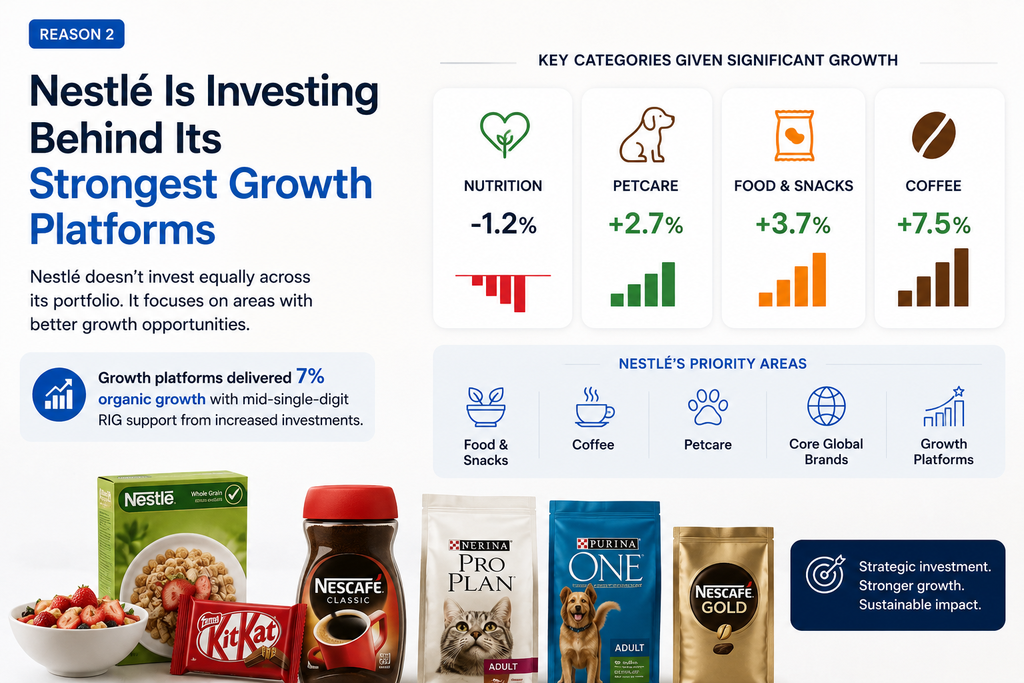
The company prioritised categories like:
- Food & snacks
- Coffee
- Petcare
- Core global brands
- Growth platforms
Here are the key categories given significant growth to Nestlé.
- Nutrition: -1.2%
- Petcare: +2.7%
- Food & snacks: +3.7%
- Coffee: +7.5% organic growth
The above data shows that the future of marketing is not about spending more money; rather, it is about spending more budget on the right growth opportunities.
Reason 3 – Brand Investment Becomes More Valuable When Competitors Become Cautious
At a time when your competitor is reducing marketing activity and advertising budget, you have a sweet spot to leverage the opportunity. The same approach was followed by Neste to maintain visibility through a different marketing approach to step ahead of other popular FMCG brands like Unilever, Ferrero, General Mills, PepsiCo, and more.
Companies that maintain their marketing and advertising activities and increase investment, unlike competitors, may gain a larger share of:
- Search demand
- Retail visibility
- Social conversation
- Consumer attention
- Mental availability
- Category consideration
Gartner’s CMO Spend Survey 2026 reveals that most marketing budgets remain almost the same in 2026 (7.8%) compared with 2025 (7.7%). However, there is pressure on CMOs to fund AI-enabled transformation through better resource allocation and sharper prioritisation.
Meanwhile, several FMCG companies planned to increase advertising spending by 10–15% in the June 2026 quarter based on improved margins and expected demand fulfilment.
Reason 4 – Nestlé Is Betting On Creativity, Not Just Media Volume
Nestlé’s marketing strategy does not revolve only around reaching out to many people through various means of media. It also includes developing ideas that can help to spark a discussion, and the KitKat Heist is one of the strongest examples.
In March 2026, 413,000+ KitKat bars were stolen during transportation from Italy to Poland. In reaction to such an event, instead of taking it as a crisis for their product brand, KitKat created a marketing technique based on it. This KitKat campaign won at Cannes Lions 2026:
- Grand Prix
- 2 Bronze Lions
- 4 Silver Lions
- 4 Gold Lions
This aligns with Nestlé’s strategy of fewer, bigger, and high-impact activities. It is not just a case of getting more impressions, but creating marketing communication that can go from:
Paid media → Earned media → Social conversation → Brand memory → Sales.
A strong creative idea can create more impact than simply increasing media volume.
Reason 5 – Digital Commerce Is Changing Where Marketing Investment Goes
Nestle reported 12.2% organic growth in e-commerce, with e-commerce reaching 21.8% of total group sales. This indicates that there is an increasing connection between advertising and commerce.
The customer journey has moved from:
Ad → search → product discovery → retailer/e-commerce → purchase.
Rather than:
TV ad → hope the consumer remembers the brand.
This gives Nestlé great opportunities to connect:
- Search
- Brand Advertising
- Digital Media
- Retailer Media
- First-Party Data
- Conversion
- Sales Measurement
The approach is similar to what professional digital marketing agencies like Digital Narada used to follow. Expert marketing strategists recommend interconnecting the resources for better tracking, improved remarketing, and increased returns on advertising.
The learning from this marketing approach is that the more measurable and simple the path from customer attention to transaction becomes, the more simple and ease for big brands to account for their marketing investment.
Reason 6 – AI Is Helping Nestlé Make Marketing More Efficient
AI is becoming another part of Nestlé’s strategy for making marketing more efficient. The goal is not to use AI to reduce marketing spend. However, it aims at the efficiency of each dollar invested in marketing activities.
Nestlé is using AI and technology in all stages of the consumer journey to make its marketing faster, more consistent, and more cost-effective.
AI can support saving time and effort for a fast response to the market in the following ways:
- Fast creative development
- Analyse consumer insight
- Personalise marketing message
- Optimise media files
- Ease demand forecasting
- Smooth content adaptation
- Measure KPIs (key performance indicators)
- Speed up campaign experiments
This gives Nestlé a simple advantage: it can continue to invest in marketing while using AI and tech to improve how that investment is beneficial.
Including AI in data analysis, forecasting, and strategy building also created a powerful equation for Nestlé:
More marketing investment + better efficiency = higher potential return on marketing spend.
What Other Companies Are Doing?
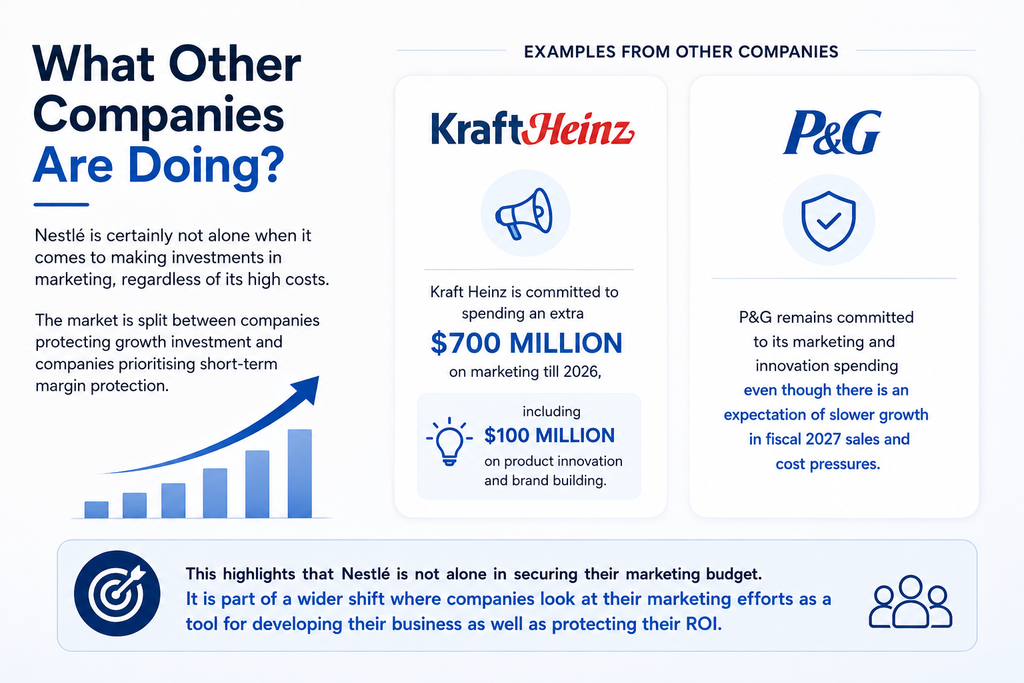
Nestlé is certainly not alone when it comes to making investments in marketing, regardless of its high costs. The market is split between companies protecting growth investment and companies prioritising short-term margin protection.
For instance:
- The company Kraft Heinz is committed to spending an extra $700 million on marketing till 2026, including $100 million on product innovation and brand building.
- P&G remains committed to its marketing and innovation spending even though there is an expectation of slower growth in fiscal 2027 sales and cost pressures.
This highlights that Nestlé is not alone in securing their marketing budget. It is part of a wider shift where companies look at their marketing efforts as a tool for developing their business as well as protecting their ROI.
5 Bigger Lessons For Marketers To Learn from Nestlé’s Approach
Nestlé’s 2026 strategy shows that increasing marketing investment does not have to mean ignoring costs. The bigger opportunity is to spend more selectively, improve efficiency, and focus on activities that can support measurable growth.
Let’s understand what we can learn from Nestlé’s smart marketing and advertising strategy.
1] Don’t cut marketing just because the economy is uncertain.
Instead, protect the activities that help maintain demand and growth.
2] Don’t protect every marketing dollar.
Instead, stop investing in low-performing marketing channels, campaigns, and activities to better optimise your budget.
3] Concentrate investment
Try to concentrate your marketing efforts on larger events rather than spreading your budget over many small ones.
4] Measure incremental growth
Look beyond impressions, clicks, CTR, CPM and leads. Instead, connect the dots, such as sales, market share, RIG, customer acquisition, repeat purchases, and revenue, and analyse results to improve your strategy.
5] Use AI to improve productivity
The competitive advantage comes from the ability to develop better marketing faster, rather than just more marketing. Marketing can become most effective through a combination of artificial investment, calculative investment, process efficiency, and unique creativity.
Verdict – Ready to Dominate with a 360-degree Approach without Cutting Investment?
Nestlé’s strategy in 2026 is not only about investing heavily in advertisements but also about making careful decisions in choosing areas to invest in and where to save money. Nestlé is saving money in other parts of its operations but investing in brands, categories, and platforms that will help achieve internal growth.
For marketers, this offers a clear lesson: the question is not simply, “Should we cut marketing?” It is, “Which marketing investments are strong enough to protect margin when budgets are under pressure?
If you are also on a journey to make a brand through an intelligent approach and smart budget management, discuss the possibilities with digital marketing experts at Digital Narada. Schedule a strategic call to pave the pathway for remarkable brand positioning in the near future.