
Meta Ads have evolved tremendously over the years. From simple 2D flyer-style advertisements in the early days to today’s AI-powered advertising ecosystem. The platform has continuously transformed the way brands connect with audiences.
1. The Manual & Micro-Targeting Era (2007–2019)
In the early days, advertisers had heavy control over campaign structure. Campaigns were defined by manual audience targeting, where marketers selected specific age groups, interests, and precise device placements.
- Ad Formats: Scaled from simple sidebar and banner ads to dynamic catalogs, video ads, Stories, and interactive AR experiences.
- Optimization: Success relied on “hacking” the algorithm with specific demographics, lookalike audiences, and custom pixel conversions.
2. The Privacy & Disruption Era (2021–2023)
Apple’s iOS 14.5 ATT (App Tracking Transparency) update severely disrupted traditional user tracking. Advertisers lost the granular, third-party data signals they had relied on for years.
- The Shift: Meta was forced to transition from relying on user-specific behavioral data to building predictive AI models that could infer intent without violating privacy constraints.
- Solutions Introduced: Meta rolled out the Conversions API (CAPI) and its Meta Advantage Suite to keep ad measurement and delivery functional using first-party data.
3. The AI and Predictive Engine Era (2024–2026)
Today, Meta’s algorithm functions as a predictive AI engine rather than just a delivery system. The platform uses Machine Learning to predict conversion potential rather than simply optimizing for engagement.
- Broad Targeting: The algorithm performs best when given wide, open audiences, allowing it to find the most likely buyers autonomously.
- Creative Fatigue: Since targeting parameters are largely automated, the “ad” itself specifically fresh, high-performing creative has become the primary targeting tool. Ads compete on a live leaderboard, where high-velocity creatives are heavily favored.
Lead Gen Forms
Lead ads allow you to find people who may be interested in your products or services . Using an instant form, you can collect contact information such as name, email address, phone number and more. These forms also let you include custom questions to help you understand your potential customers and reach your business goals.
Lead Generation on meta ads
Lead generation on Meta Ads is quite similar to what marketers do on platforms like LinkedIn Ads and Google Ads. One of the biggest advantages of Meta Ads is its relatively lower cost per click (CPC). Which makes it an attractive platform for businesses looking to generate leads at scale.
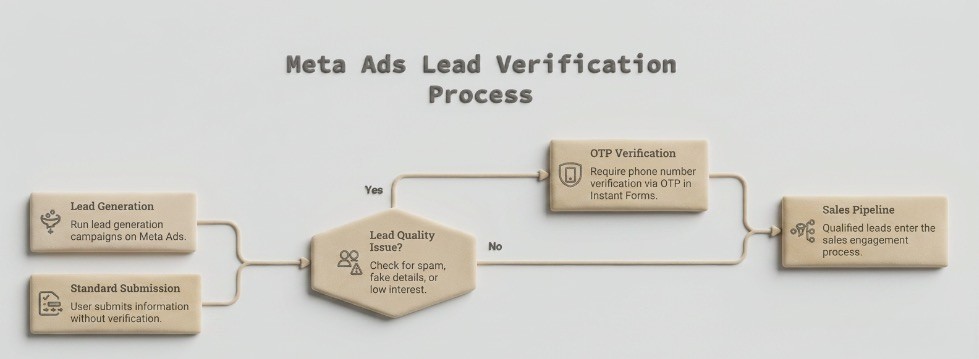
However, lead quality has always been a major concern. Many advertisers have experienced issues with spam submissions, fake contact details, or leads. That show little to no genuine interest in their products or services. As a result, businesses often spend valuable time and resources following up with unqualified prospects.
To address this challenge, Meta has introduced additional lead verification features, including OTP (One-Time Password) verification within Instant Forms. By requiring users to verify their phone numbers before submitting their information. Businesses can significantly reduce the number of spam and invalid leads entering their sales pipeline.
While OTP verification is not a complete solution to lead quality issues, it is a valuable step toward ensuring that the leads generated through Meta Ads are more authentic, reliable, and easier for sales teams to engage with.
To help your lead ad perform better
- Include an engaging image or video and relevant call to action in your ad: Your lead ad should encourage people to click on it to open the instant form. Make your ad as engaging as possible and clearly communicate why people should fill out your form.
- Determine the right budget: Global reach can scale your campaign quickly. But receiving thousands of leads in a short time can overwhelm your sales team or call centres. Use ad scheduling in the Advantage+ campaign budget (formerly known as campaign budget optimisation) section of Meta Ads Manager to ensure that your team will be ready to respond to leads as they are submitted.
- Run your ad on Facebook, Instagram and WhatsApp: Extend the reach of your campaign by using Advantage+ placements (formerly known as automatic placements) to deliver ads on both Facebook, Instagram and WhatsApp. This optimises delivery to reach the most relevant people in a platform-agnostic manner. Note that not all features are available on Instagram.
Note: Advertisers who have used brand safety and suitability controls on Facebook, Instagram or Threads in the past 12 months are automatically opted out of the WhatsApp Status placement. - Reach people who look like your best customers: Use a lookalike audience to reach people with characteristics similar to your current customers. For lead ads, we recommend using an audience based on existing customers rather than those who have submitted a form so you can reach the people that are likely to provide the most value to your business.
- Reach people who previously engaged with your lead ad: Create an engagement custom audience to reach people who started your instant form but never finished it. Capitalise on this intent to encourage them to finish and submit your form.
- Connect your CRM to reach people who are more likely to convert. Share information about your leads from your CRM (Customer Relationship Management) system so we can optimize to reach higher quality leads in your audience. Learn more about how to set up your CRM for conversion leads.
Final Thoughts
Meta lead generation is far from dead. Yet, success today requires a more thoughtful, data-driven approach. By focusing on qualification, alignment, and optimization across the full funnel, businesses can consistently generate high-quality leads that turn into revenue.
The key is moving beyond volume and focusing on what truly matters: leads that convert. With the right strategy, Meta can remain one of your most reliable and scalable lead generation channels.
Need Help Optimizing Your Meta Lead Gen Strategy?
If you’re struggling with lead quality or want to get more out of your Meta advertising investment. Our team specializes in building data-driven campaigns that deliver real, qualified leads not just form fills. Contact us today to learn how we can improve your Meta performance and turn more leads into customers.