
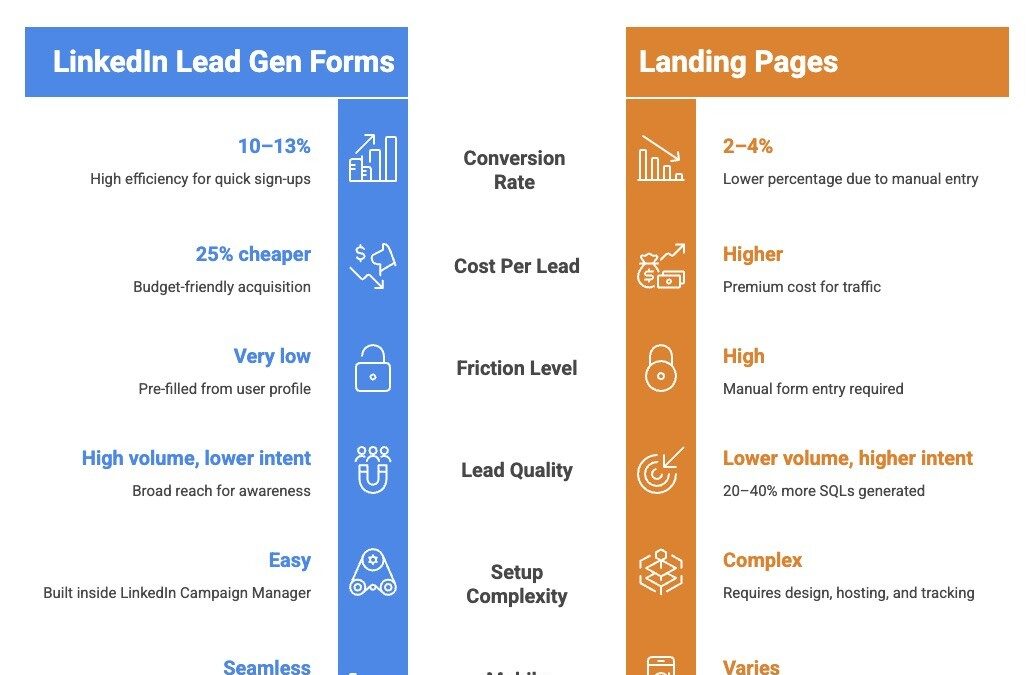
| 13% Lead Gen Form Conversion Rate | 2–4% Landing Page Conversion Rate | 5x LGF Outperforms Landing Pages | 25% Lower CPL with Lead Gen Forms |
You’re running LinkedIn Ads for your B2B company in India. You have a great offer — a free demo, an industry report, a webinar, a product trial. And you’re about to make the decision that will define whether your campaign generates 20 leads or 80.
Do you use LinkedIn’s native Lead Gen Form, or do you send traffic to a landing page on your website?
Both options have passionate advocates. Both have real advantages. And most blog posts on this topic give you a vague “it depends” answer and leave you exactly where you started.
This guide doesn’t. It gives you the actual conversion data, the specific India-market context that changes the calculus, and a decision framework that tells you exactly which format to use based on your offer, your funnel stage, and your sales team’s capacity.
Let’s get into it.
First: What Are We Actually Comparing?
LinkedIn Lead Gen Forms
LinkedIn Lead Gen Forms are native, in-platform forms that appear when a user clicks on your Sponsored Content ad. The moment the form opens, it pre-populates with the user’s LinkedIn profile data: name, email, job title, company name, company size, and more.
The user sees a pre-filled form. They review it, click Submit, and it’s done. They never leave LinkedIn. No new tab opens, page loads. No form fields to type into.
This is the entire source of their power — and their limitation.
Landing Pages
A landing page is a standalone page on your website, built specifically to convert one type of visitor on one type of offer. The user clicks your LinkedIn ad, exits LinkedIn, and arrives at your page. They read your copy, review your offer, and fill out a form manually.
Every step in this journey introduces friction. The page has to load. The form has to be visible. The user has to type their information. And the offer has to be compelling enough to keep them engaged through all of it.
That friction is both the biggest weakness of landing pages — and their biggest strategic asset.
The Data: What the Numbers Actually Say
Let’s not bury the headline. Here is what current performance benchmarks show:
| Metric | LinkedIn Lead Gen Forms | Landing Pages |
|---|---|---|
| Avg. Conversion Rate | 10–15% (peak: 20%) | 2–4% (peak: 10–12%) |
| Cost Per Lead (India) | ₹2,500 – ₹6,000 | ₹4,000 – ₹12,000 |
| Form Completion Rate | High — pre-filled data | Lower — manual entry |
| SQL Rate (Sales Qualified) | Lower — less friction = less filter | 20–40% higher |
| Lead Data Accuracy | LinkedIn-verified profile data | Self-reported, can vary |
| Setup Complexity | Low — built inside Campaign Manager | High — requires page build + tracking |
| Retargeting Capability | Limited outside LinkedIn | Full website pixel retargeting |
| Mobile Experience | Excellent — seamless | Varies — depends on page speed |
The headline number: Lead Gen Forms convert at 13% on average, compared to 2.35% for external landing pages — that is a 5x difference. For the same ad spend, you generate roughly 5 times more leads with a Lead Gen Form.
However, one key metric that many blogs overlook is SQL rates (Sales Qualified Leads). While LinkedIn Lead Gen Forms often generate higher lead volumes, landing pages can improve SQL rates by 20–40%. This is mainly because the additional steps help filter out low-intent users. For instance, users who click an ad, explore the landing page, read the offer, and manually enter their information usually show stronger purchase intent. In contrast, pre-filled Lead Gen Forms allow users to submit their details quickly. As a result, businesses may receive a higher number of leads, but the overall lead quality can sometimes be lower.
| ⚠️ The Critical Trade-Off : Lead Gen Forms win on volume and cost-per-lead. Landing pages win on lead quality and SQL conversion rate. Choosing between them without understanding this trade-off is the most common LinkedIn Ads mistake Indian B2B companies make. |
The India Context: Why This Decision Is Different Here.
Most benchmarks and case studies for this comparison come from US or European markets. The Indian B2B market has specific dynamics that shift the calculus significantly.
Mobile-First Behaviour
India has one of the highest rates of mobile LinkedIn usage in Asia-Pacific. A significant portion of your target audience — the CFO in Hyderabad, the CTO at a Pune SaaS company, the Head of Operations in Chennai — is scrolling LinkedIn on mobile during commutes, between meetings, or in the evening.
For mobile users, landing pages are brutal. A page that takes 3 seconds to load loses 53% of mobile visitors before it even renders. Your carefully designed landing page, with its hero image and testimonials section, becomes a conversion killer on a 4G connection in peak hours.
Lead Gen Forms, by contrast, are natively optimised for mobile. No load time. No typing on a small keyboard. One tap to submit. On mobile, this difference in conversion rate isn’t 5x — it can be 8–10x.
Professional Email Reliability
In Western markets, LinkedIn profile emails are frequently personal addresses (Gmail, Hotmail) that marketing and sales teams can’t always use for business outreach. In India, LinkedIn profiles are more likely to carry business email addresses — particularly for senior professionals at established companies.
This makes Lead Gen Form data more directly usable for Indian B2B sales teams, reducing the verification and enrichment step that adds friction to the follow-up process.
Sales Cycle Expectations
India’s B2B market — especially in SaaS, IT services, and consulting — operates on long sales cycles with multiple stakeholders. A lead from a Lead Gen Form who filled out a contact form for a whitepaper is typically early in the research phase. A lead from a landing page with a demo CTA has demonstrated enough intent to self-select into a sales conversation.
This means the landing page’s higher SQL rate is especially valuable for Indian B2B companies with small sales teams — where time spent on unqualified calls is a real operational cost.
| India-Specific Insight : If your target audience is senior decision-makers (CFO, CTO, VP-level) at Indian enterprises, Lead Gen Forms work well for top-of-funnel content offers. But if your offer is a product demo or a paid consultation, a high-converting landing page will save your sales team from chasing low-intent leads — especially if you have a lean inside sales team. |
Exactly When to Use Each — by Offer Type and Funnel Stage
Here is the decision framework. Match your offer type to the right format:
| Offer Type | Use This | Reason |
|---|---|---|
| Industry report / whitepaper download | Lead Gen Form | Low commitment, TOF, volume play |
| Webinar / event registration | Lead Gen Form | Seamless registration, high show-up rates |
| Free resource (checklist, template) | Lead Gen Form | Maximum reach, email list building |
| Newsletter subscription | Lead Gen Form | Lowest friction = highest volume |
| Free product demo / trial | Landing Page | Demo requires intent — friction filters for it |
| Consultation / strategy call booking | Landing Page | High-value ask needs trust-building copy |
| Pricing / custom quote request | Landing Page | Purchase-stage lead needs qualification |
| Case study access (high-value) | Either — test both | Depends on target account tier |
| Enterprise contract / ABM campaign | Landing Page | Complex offer needs full messaging space |
The Funnel Rule
If in doubt, follow this one rule: Lead Gen Forms for top-of-funnel offers, landing pages for bottom-of-funnel offers.
- Top-of-funnel (Awareness stage): Content downloads, webinar registrations, newsletter sign-ups → Lead Gen Forms
- Mid-funnel (Consideration stage): Case studies, comparison guides, free tools → Either, test both
- Bottom-of-funnel (Decision stage): Demo requests, free trials, pricing enquiries, consultations → Landing Pages
A Complete Blueprint for High-Converting LinkedIn Lead Gen Forms
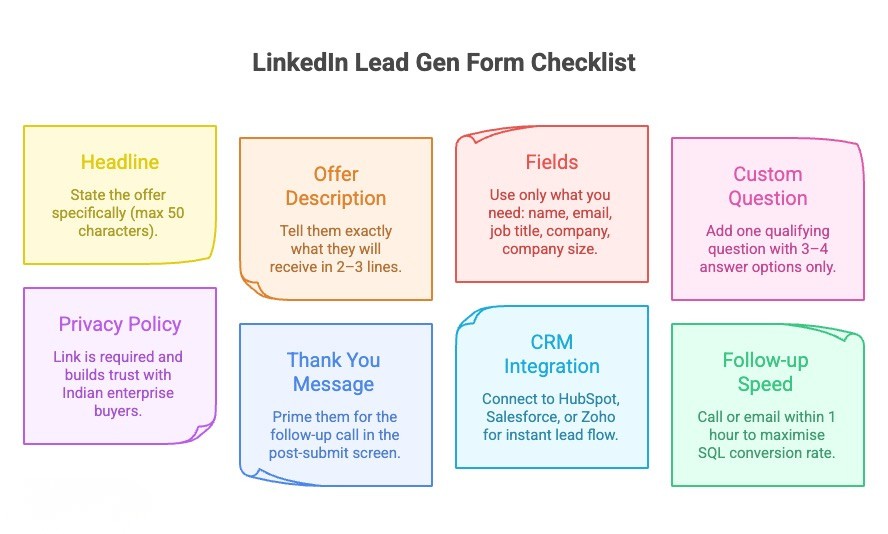
Most LinkedIn Lead Gen Forms underperform not because the format is wrong, but because the form itself is set up poorly. Here’s what a high-converting form looks like for Indian B2B campaigns:
Headline (50 characters max)
This is the first thing users see when the form opens. It should state the offer clearly and immediately. Not: “Get in touch with our team.” Instead: “Download: 2025 GST Compliance Benchmark Report.” Specific beats generic every time.
Offer Details (2–3 lines)
Describe exactly what the person will receive. “A 22-page report covering GST reconciliation errors across 500+ Indian manufacturing companies, with a step-by-step fix guide.” The specificity signals value and reduces drop-off at the form review stage.
Ask Only What You Need
LinkedIn pre-fills standard fields (name, email, job title, company, company size). For most top-of-funnel offers, these five fields are enough. Every additional custom question reduces your conversion rate by approximately 5–10%. Only add custom questions if they are essential for lead qualification.
Good custom question for Indian B2B: “What is your primary compliance challenge today?” with 3–4 answer options. This qualifies the lead without adding friction.
Privacy Policy Link
LinkedIn requires a privacy policy link. This is also an India-specific trust signal — senior professionals at Indian enterprises are increasingly privacy-conscious. Make sure your privacy policy URL is live and the page is functional.
Thank You Message
The post-submission message appears immediately after the user submits. Use it actively: “Your report is on its way. Our team will also reach out within 24 hours to discuss your GST reconciliation setup.” This primes them for the sales call, reducing cold-call friction later.
| Pro Tip for India : Set up a CRM integration (HubSpot, Salesforce, or Zoho CRM are all natively supported by LinkedIn) so leads flow directly from LinkedIn into your CRM within 5–15 minutes. The speed-to-lead window in Indian B2B is critical — a follow-up call within 1 hour increases conversion rates by 60% compared to calling after 24 hours. |
How to Build a High-Converting LinkedIn Landing Page
If your offer demands a landing page, the page needs to do the heavy lifting your Lead Gen Form doesn’t get the chance to do: build trust, communicate value, and qualify intent.
The Non-Negotiables for B2B India Landing Pages
- Page load time under 2 seconds on mobile. Every extra second costs you 7% of your conversions. Use Google PageSpeed Insights to benchmark before launching any campaign.
- Headline that matches the ad. If your LinkedIn ad says “Book a Free GST Audit”, your landing page headline must say exactly that. Message mismatch is the single biggest conversion killer on landing pages.
- One CTA only. No navigation menu, no footer links, no ‘Learn More’ buttons scattered through the page. One offer, one button. Every exit option is a lost conversion.
- Social proof that is specific and Indian. ‘Trusted by 500+ companies’ is weak. ‘Used by Finance Controllers at 320 Indian manufacturing firms’ is strong. Name recognisable Indian companies where possible.
- Mobile-optimised form. Form fields should be large enough to tap easily. Auto-fill should be enabled. The submit button must be visible without scrolling on a standard mobile screen.
- Clear privacy statement near the form. Indian B2B buyers, particularly at larger companies, are trained to look for this before submitting contact details.
The Landing Page Trust Stack
For bottom-of-funnel offers (demos, consultations), your landing page needs to do trust-building work. The sequence that converts best for Indian B2B:
- Clear headline (what you’re offering, who it’s for)
- 2–3 bullet-point benefits (what they get, not what you do)
- One specific social proof element (a named client result or testimonial)
- The form (short — name, email, company, one qualifying question)
- A trust footer (Google Partner badge, client logos, privacy note)
The Strategy That Outperforms Both: The Hybrid Funnel
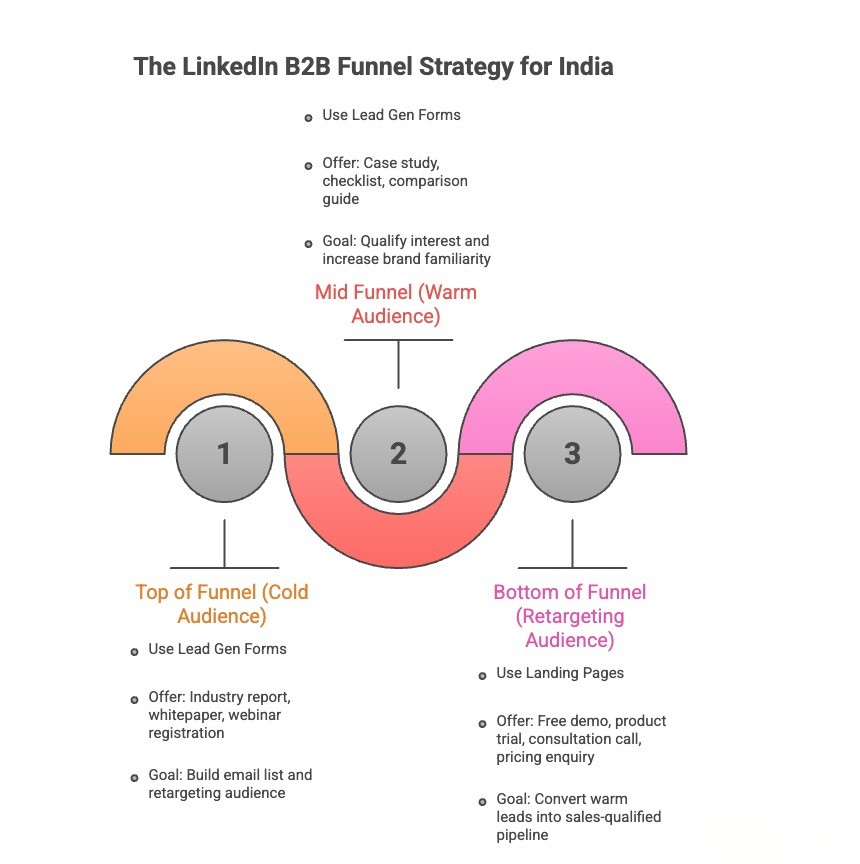
The most effective B2B LinkedIn campaigns in India don’t choose between Lead Gen Forms and landing pages. They use both, sequenced across the funnel.
Here’s how it works:
| Stage | Ad Format | Conversion Method | Goal |
|---|---|---|---|
| TOF — Week 1–2 | Sponsored Content / Video | Lead Gen Form | Capture email + build audience |
| MOF — Week 3–4 | Carousel / Document Ad | Lead Gen Form | Qualify interest, serve value |
| BOF — Week 5+ | Single Image / Message Ad | Landing Page | Convert warm leads to demo/call |
The Lead Gen Form audience at the top of the funnel becomes your retargeting pool for the landing page campaign at the bottom. You’re not losing the Lead Gen Form leads — you’re warming them up for the higher-commitment ask.
This hybrid approach consistently outperforms a single-format strategy because it matches the format to the intent level of the audience at each stage. The data from multiple Indian B2B campaigns at Digital Narada bears this out: hybrid funnel campaigns generate 60–70% of budget on lead gen forms and 30–40% on landing pages, with bottom-funnel landing page spend delivering the highest pipeline contribution per rupee.
| The 70/30 Rule for Indian B2B : Allocate 70% of your LinkedIn Ads budget to Lead Gen Forms targeting cold and warm audiences. Allocate 30% to Landing Pages targeting retargeting audiences who have already engaged with your content. This split consistently delivers the best CAC-to-pipeline ratio for B2B companies in India. |
The Ultimate Q&A Guide for Indian B2B Marketers
Can I use Lead Gen Forms for demo requests?
You can, but it’s rarely the best choice. A Lead Gen Form for a demo request generates high volume but low SQL rate — your sales team ends up chasing leads who submitted in 3 seconds and have no real intent to buy. Use a landing page for demo requests. Use a Lead Gen Form to offer a resource first, then retarget form-submitters with a demo landing page.
My Lead Gen Form leads have wrong email addresses. What’s happening?
This is a common India-specific issue. Some LinkedIn users have an old or personal email as their primary contact, which auto-populates in the form. You can’t fix the auto-fill, but you can add a custom question asking them to confirm or update their email. Alternatively, ensure your CRM integration has an email verification step before leads enter your sales sequence.
How long should my landing page be for LinkedIn traffic?
For top-of-funnel LinkedIn traffic (cold audiences clicking a content offer): short. 400–600 words, one clear CTA, minimal scrolling. For bottom-of-funnel (warm retargeting audiences for demos or consultations): medium. 700–1,000 words with social proof, objection handling, and a strong benefits section. Long-form landing pages work for high-ACV enterprise offers where trust is the primary barrier.
Should I use Lead Gen Forms for LinkedIn Message Ads (InMail)?
Yes — this is an underused combination in India. Message Ads with an embedded Lead Gen Form CTA deliver some of the highest conversion rates on the platform for ABM campaigns. The personal nature of a message, combined with the frictionless form, works particularly well for senior decision-maker targeting at named accounts.
How do I track Lead Gen Form performance in Google Analytics?
You cannot track LinkedIn Lead Gen Form submissions in Google Analytics because the form is submitted inside LinkedIn, not on your website. Track Lead Gen Form performance inside LinkedIn Campaign Manager (form fill rate, CPL, lead volume) and in your CRM (SQL rate, pipeline contribution). For unified reporting, use a BI tool like Looker Studio to pull data from both sources.
The Verdict: Which One Should You Use?
Here is the direct answer:
Best suited for using LinkedIn Lead Gen Forms:
- Your offer is a content download, webinar, or free resource
- Your audience is cold or early-stage — they don’t know you yet
- A significant portion of your audience browses LinkedIn on mobile
- You want to build a retargeting audience quickly
- Your sales team has capacity to qualify and follow up on higher volume
Ideal scenarios for using a Landing Page:
- Your offer is a demo request, consultation, or pricing enquiry
- Your audience is warm — retargeting people who already know your brand
- Your offer is complex and requires trust-building copy and social proof
- Your average deal value is high and SQL quality matters more than lead volume
- You need full website tracking, retargeting pixels, and first-party data
Use both in sequence when:
- You have a sufficient monthly budget (minimum ₹30,000 ad spend on LinkedIn)
- You have a content asset for the top of the funnel and a sales offer for the bottom
- You have CRM integration and a defined lead scoring process
- You want the best possible pipeline contribution from your LinkedIn spend
The format that wins is the one that matches your offer, your audience intent, and your sales team’s capacity. There is no universal answer — but there is always a right answer for your specific situation.