
Stop marketing to everyone. Seriously.
Here is a scenario that plays out inside B2B companies across India approximately once every quarter:
Marketing runs LinkedIn campaigns. Leads come in. Sales calls the leads. Sales comes back to marketing with that particular expression — somewhere between confused and personally offended — and says: “These people are not our buyers.” Marketing points to the dashboard. Sales points to the empty pipeline. Nobody points to the root cause.
The root cause is almost always the same: you are marketing to an audience, when you should be marketing to a list.
That shift — from audience-based targeting to account-based targeting — is what account-based marketing (ABM) is. And LinkedIn, with its ability to show ads specifically to named companies and specific job titles within those companies, is the most precise tool available for running it in India.
At Digital Narada, we have run LinkedIn ABM programmes for B2B companies in SaaS, IT services, consulting, and fintech across Bangalore, Mumbai, Pune, and Hyderabad. This guide is everything we know about doing it right — structured as a step-by-step playbook you can actually execute.
If you are still getting familiar with how LinkedIn advertising works before going deep on ABM, start with our explainer on LinkedIn Ads for B2B companies in India first. It lays the foundation this guide builds on.
What ABM actually is (and what it is not)
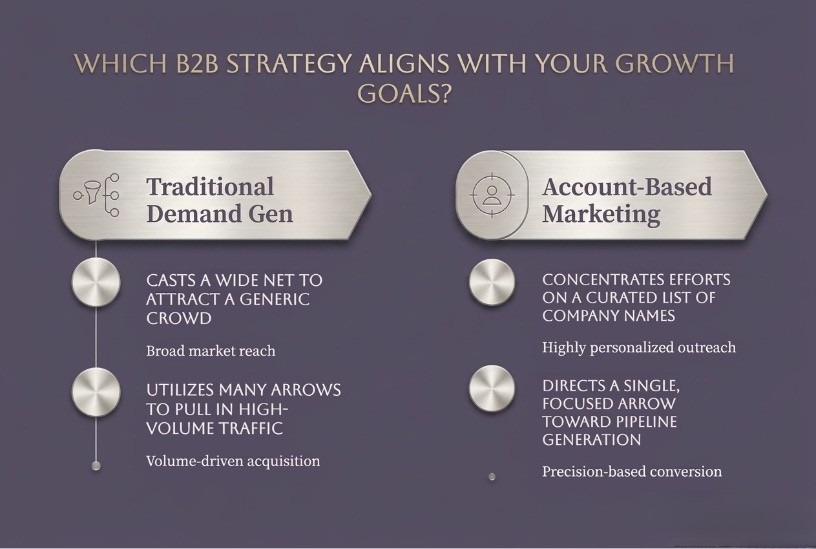
Account-based marketing is a B2B growth strategy where your sales and marketing teams align around a defined list of high-value target accounts — and build campaigns designed specifically to engage, nurture, and convert decision-makers at those companies.
It is not a campaign type and not a LinkedIn feature. It is a go-to-market motion that uses LinkedIn (among other channels) as its primary activation surface.
What makes it different from standard LinkedIn advertising?
Standard LinkedIn ads say: “Here is my ideal customer profile. Find me people who match it.” ABM says: “Here are the 200 specific companies I want to close this year. Show my ads only to the right people inside those companies.” The first approach generates leads. The second approach generates pipeline from accounts that are actually worth closing.
The three ABM tiers: pick your level
- One-to-one (Strategic ABM): 10–30 enterprise accounts. Every ad, every message, every landing page is built for that specific company. High effort, highest deal size
- One-to-few (ABM Lite): 50–200 accounts grouped into clusters by industry or use case. Messaging is personalised at the cluster level. The sweet spot for most Indian B2B companies
- One-to-many (Programmatic ABM): 300–1,000 accounts. Technology handles personalisation at scale. Requires more infrastructure but extends ABM principles to a broader target universe
Most Indian B2B companies reading this guide are best served starting with One-to-few. It is specific enough to drive quality, practical enough to execute without a 10-person marketing team.
Why the Indian B2B market rewards ABM more than most
ABM works everywhere. But it works particularly well in India — for three structural reasons that most B2B marketing frameworks written in San Francisco tend to miss entirely.
Deals are relationship-led, not form-led
Indian enterprise buying decisions are rarely triggered by a single ad click or a cold email. They are triggered by familiarity, trust, and repeated exposure to a brand that appears to understand the buyer’s context. ABM creates that familiarity deliberately — by showing the right content to the right people at your target accounts, consistently, over a 60–90 day period. By the time your sales team reaches out, the prospect already recognises you. That recognition is worth more than any CTA button.
Every deal involves a committee, not a person
The average B2B purchase decision in an Indian company with 200–2,000 employees involves 4–7 stakeholders. The CFO needs the ROI case. The CTO needs the integration story. The Department Head needs the workflow continuity assurance. ABM on LinkedIn lets you run tailored campaigns to all of them simultaneously — so when the buying committee sits down to compare vendors, every person in the room has already heard of you.
Sales cycles are long — which means early impressions compound
Indian B2B sales cycles average 3 to 9 months. That is a long window during which a competitor who started their ABM programme earlier is building equity in your target accounts while you are waiting for intent signals. ABM rewards the company that starts first and stays consistent. It is compounding interest, applied to pipeline.
For companies building a multi-channel ABM motion, B2B email marketing sequences can run in parallel with LinkedIn to create consistent touchpoints across platforms — so your brand shows up whether a prospect is in their inbox or their feed.
Step 1: Build your ICP and target account list
Here is where most ABM programmes fail before they even start: the account list is either too broad, too aspirational, or just plain wrong. Your target account list is not a wish list of logos you would like on your website. It is a data-driven selection of companies most likely to buy from you, succeed with your product, and generate the lifetime value that makes the campaign worth running.
Define your Ideal Customer Profile with precision
Pull your last 24 months of closed-won data. Find the patterns. The ICP variables that matter most for Indian B2B:
- Industry vertical — be specific. Not “technology” but “B2B SaaS companies selling to enterprise HR teams”
- Company size by headcount and revenue band — the buying process at a 200-person company is structurally different from a 2,000-person company
- Geography — metro-focused, pan-India, or specific cities. LinkedIn lets you get precise
- Growth stage — Series A–C startups have different budget cycles than bootstrapped profitable firms or listed enterprises
- Tech stack signals — if you sell a product that integrates with Salesforce, “uses Salesforce” is a powerful ICP qualifier
- Buying trigger signals — recent funding round, leadership hire, new product launch, regulatory change in their industry
Build the list
With your ICP defined, build your account list from:
- LinkedIn Sales Navigator — filter by industry, headcount, geography, and growth signals. Export a CSV
- Your CRM — extract patterns from existing customers and identify lookalike companies
- Intent data — Bombora, G2, and TechTarget show you which companies are actively researching your category right now
- News triggers — funding announcements, leadership changes, hiring sprees, and expansion news on platforms like Tracxn, Inc42, or LinkedIn itself
For a One-to-few ABM campaign, 100–200 target accounts is the right starting range. Enough to give LinkedIn’s algorithm something to work with; focused enough that your messaging can be meaningfully specific.
Step 2: Map the buying committee — all five of them
Targeting only the CEO or CTO of your target accounts is the ABM equivalent of pitching a film to only the director and ignoring the producer, the studio executive, and the distributor. All of them have a vote. Ignore any of them at your peril.
Who actually needs to say yes before your deal closes?
The five roles you typically need to reach:
- The Economic Buyer: Controls the budget. CFO, VP Finance, Business Unit Head. Cares about ROI, cost reduction, and risk
- The Technical Buyer: Evaluates fit and feasibility. CTO, Head of IT, Senior Architect. Cares about integration, security, and engineering overhead
- The User Buyer: Lives with the product every day. Operations Head, Department Manager, Team Lead. Cares about workflow disruption and team adoption
- The Champion: Your internal advocate — the person who wants this problem solved and will argue for your solution in rooms you will never be in
- The Blocker: Has legitimate concerns about change, cost, or risk. Ignoring them does not make them go away. Address their objections in your content before the sales call ever happens
LinkedIn lets you target all five roles within your matched account list simultaneously, with different creatives, different messages, and different content for each. This is the structural advantage ABM has over every other lead generation approach — you are not hoping the right person sees your ad. You are ensuring they do.
For companies running paid search alongside LinkedIn ABM, Google Ads can intercept the same buying committee members when they proactively search for solutions — creating a two-channel surround that reinforces your positioning at every stage of their research.
Step 3: Set up your LinkedIn ABM campaign architecture
LinkedIn Campaign Manager works in three tiers: Campaign Groups, Campaigns, and Ads. Your ABM architecture should mirror your funnel stages and your audience segments — not just your ad formats.
The structure that works
Campaign Group 1 — Awareness (Industry Cluster A)
- Campaign 1A: Document Ad or Insight Post — Economic Buyers at target accounts
- Campaign 1B: Document Ad or Insight Post — Technical Buyers at target accounts
Group 2 — Consideration (Retargeting engaged accounts)
- Campaign 2A: Case study carousel — retargeting accounts that engaged with Awareness campaigns
- Campaign 2B: Product/solution content — decision-makers from target accounts who visited your website
Group 3 — Conversion (Hot accounts)
- Campaign 3A: Lead Gen Form with demo or audit offer — accounts warm from TOF and MOF engagement
- Campaign 3B: Message Ads (InMail) — personalised one-to-one outreach to Champions and Economic Buyers at priority accounts
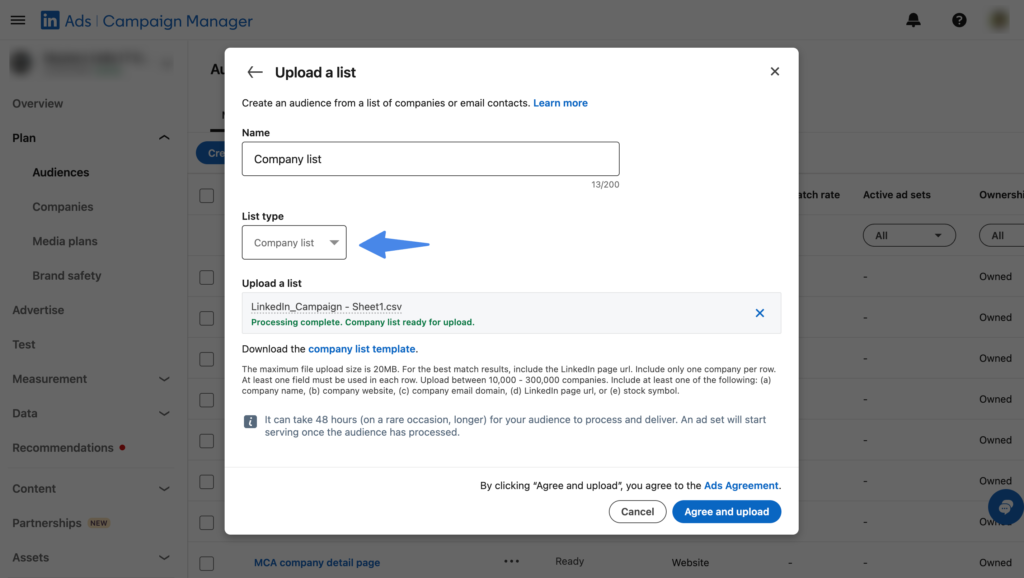
How to upload your account list
In Campaign Manager, go to Account Assets → Matched Audiences → Upload a List. Upload your CSV of target company names. LinkedIn matches them against its database — expect a 70–85% match rate for Indian companies. Your campaigns then target only employees at matched accounts, filtered by the job titles and seniority levels you define.
One important note: do not target all employees at your matched accounts. That turns ABM into expensive brand advertising. Target only the 3–5 job titles per account that correspond to your buying committee. The tighter the targeting, the better the signal quality — and the more efficiently your budget is deployed.
Step 4: Pick the right ad format for each funnel stage
LinkedIn offers more ad formats than most advertisers use — and most of those unused formats are exactly the ones that perform best in ABM. Here is the honest breakdown:
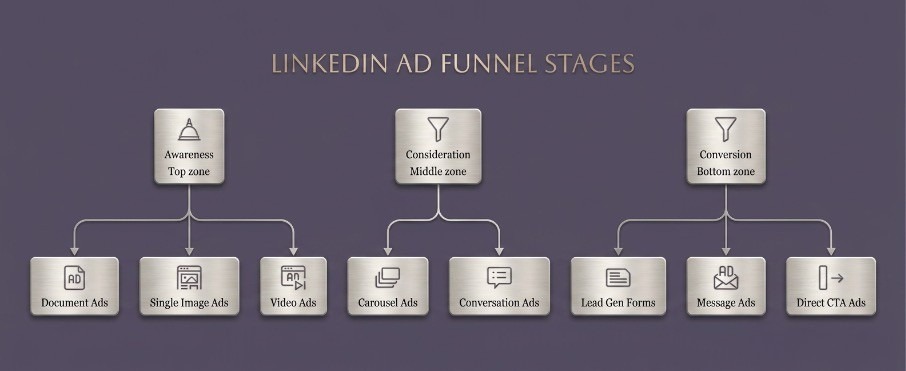
Top of funnel: build recognition before you ask for anything
- Document Ads: share a genuinely useful industry report, framework, or playbook relevant to your target account cluster. This is the highest-performing TOF format in India — low cost-per-engagement, strong intent signal, and it positions you as a domain expert before your sales team says a word
- Single Image Ads: insight-led posts that address a specific, painful problem your target accounts face. Not “We help companies grow” — that tells the reader nothing. “Why 73% of Indian SaaS companies struggle with enterprise procurement cycles” — that makes the CFO stop scrolling
- Video Ads: 30–60 second videos that name the problem and hint at the mechanism. Strong for brand recall across the full buying committee
For a detailed look at which LinkedIn ad formats deliver the best cost-per-lead at each funnel stage for Indian B2B campaigns, read Digital Narada’s guide on LinkedIn Lead Gen Forms vs landing pages.
Middle of funnel: prove the claim
- Carousel Ads: 3–5 cards, each featuring a different customer success story or use case scenario. Link each card to a dedicated case study page — let the reader self-select by relevance
- Conversation Ads: multi-CTA message ads that let prospects choose their own path. “Read a case study” / “See how it works” / “Book a demo” in one ad. Best used for accounts that have shown TOF engagement — it is a choose-your-own-adventure for qualified buyers
Bottom of funnel: make it easy to raise their hand
- Lead Gen Forms: target only accounts that have engaged with your TOF and MOF content. The offer must match their readiness — a demo for a warm account, an audit or consultation for a cooler one
- Message Ads (InMail): personalised messages under 300 words to your Champion and Economic Buyer at the accounts showing the most engagement. Lead with a specific, relevant observation. End with one clear, low-friction CTA
- Direct Single Image Ads: for accounts that are demonstrably in evaluation mode, a clean “Book a 30-minute strategy call” ad often outperforms every piece of clever messaging you spent three hours writing
Step 5: Write messaging that actually feels personal
ABM personalisation is not putting the company name in the headline and calling it contextual. Anyone can do that. What makes ABM messaging genuinely effective is when the reader sees your ad and thinks: “This is written for someone exactly like me, dealing with exactly this problem.” That reaction does not happen by accident.
The personalisation framework that works
For each target account cluster and each buying committee role, build your messaging around five components:
- Their specific problem: name it precisely, in the language they use — not the language your product team uses
- The cost of inaction: what is actually at risk for their business if this problem is not solved in the next 6–12 months
- Your unique mechanism: not just what you do, but why your approach solves this better than the alternatives they are already considering
- A proof point: a customer from a comparable industry, a specific metric, a before-and-after scenario that makes the claim credible
- The next step: one clear, appropriately-sized ask for where they are in the funnel — not a demo request on a first impression
Test this: if your ad copy could be seen by a manufacturing CFO in Pune and a marketing manager at a Bangalore startup, and neither of them would feel like it was irrelevant — your messaging is not specific enough. The precision is the point.
Step 6: Connect your tracking to your CRM
Here is the part most marketers skip because it sounds operational and unglamorous. It is also the part that determines whether your ABM programme generates business value or just generates reports.
Install the LinkedIn Insight Tag — today, not eventually
The Insight Tag goes on every page of your website and enables three things that are non-negotiable for ABM: website retargeting (ads that follow target account visitors across LinkedIn), website demographic reporting (see which job titles and companies are visiting which pages), and conversion tracking (know which ads drove which actions).
Connect LinkedIn leads to your CRM in real time
LinkedIn Lead Gen Form submissions must flow directly into your CRM — HubSpot, Salesforce, Zoho, Leadsquared — without a manual export step. Every hour between a lead submitting a form and your sales team seeing it is an hour your competitor could be having the conversation you should be having.
Digital Narada’s AI and automation service handles exactly this — connecting LinkedIn lead data to your CRM pipeline with enrichment, so your sales team sees account context and engagement history, not just a name and an email address.
Track accounts, not just leads
Standard marketing dashboards track individual leads. ABM dashboards track account progression. Build a view in your CRM that shows:
Which target accounts have engaged with your LinkedIn content
Which stakeholders at each account have filled forms or visited key pages
Where each account sits in your pipeline — and how long it has been there
Which accounts have gone quiet and need a re-engagement nudge
This is not extra work. It is the entire point of ABM — and without it, you are running account-based ads with lead-based measurement. The two do not produce the same conclusions.
Step 7: Measure with ABM metrics, not demand-gen metrics
The most reliably damaging thing that happens to ABM programmes in Indian B2B companies is this: the leadership team evaluates the campaign using demand-gen metrics, sees a higher CPL than the previous lead generation campaign, and pulls the budget.
ABM targets a curated list of high-value accounts. The audience is intentionally small. The CPL will be higher. The deal size, close rate, and pipeline velocity will more than compensate — but only if you measure the right things.
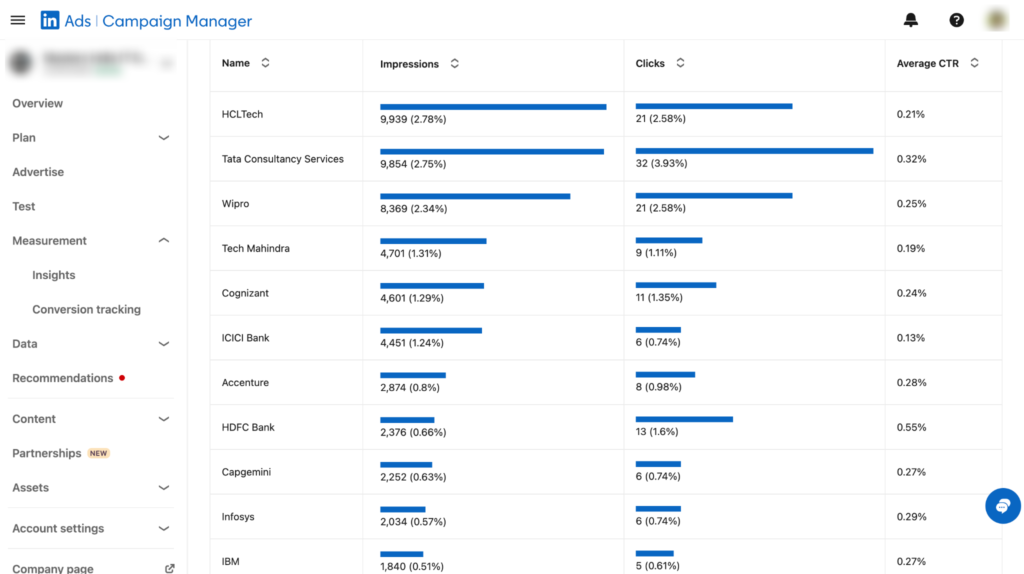
The metrics that actually tell you if ABM is working
- Account coverage: what percentage of your target accounts have at least one stakeholder who has seen your ads? Aim for 70%+ within the first 60 days
- Account engagement rate: of accounts reached, how many have engaged — clicked, downloaded, visited your site? A 15–25% engagement rate indicates your targeting and messaging are working
- MQL-to-SQL conversion rate: ABM leads should convert to Sales Qualified Leads at 30–50% higher rates than standard inbound, because they were pre-selected to fit your ICP
- Sales cycle velocity: are ABM-sourced accounts moving through your pipeline faster? Expect a 20–35% reduction in average sales cycle duration when ABM is working correctly
- Average deal size: track this separately for ABM-sourced pipeline versus non-ABM. The difference is typically significant — and it is the number that justifies the programme to leadership
- Pipeline ROI: total pipeline value from target accounts divided by total ABM spend. This is your north-star metric
For companies running both paid social and paid search as part of their B2B marketing mix, pair these ABM metrics with Google Ads performance data to understand how many of your pipeline deals are being influenced across multiple touchpoints before they close — not just the last click.
The ABM mistakes that quietly kill campaigns
These are not the obvious mistakes. The obvious ones — no conversion tracking, no negative keywords, homepage as landing page — everyone knows those. These are the subtler failures that look fine on the surface until the quarter ends and the pipeline does not.
The account list that is actually a wish list
There is a version of ABM where the target account list looks like the attendee list at a fantasy conference — every major enterprise in your industry, every logo that would look good on your case study page, every company your CEO has mentioned wanting to close. That is not a target account list. That is a hope list.
Real ABM account lists are built from data: your best existing customers, your highest-velocity deals, your strongest product-market fit signals. If a company would be a genuinely great customer, it earns a place on the list. If it just looks impressive, it wastes your budget.
Running ABM for three weeks and declaring it broken
ABM requires a minimum 60–90 day runway. Awareness campaigns need 4–6 weeks to build frequency at target accounts. Retargeting pools take time to accumulate. Sales conversations from ABM-influenced accounts typically begin 45–75 days after first exposure. Evaluating ABM at week three is the equivalent of planting a mango tree and checking for fruit the following Tuesday.
Dropping personalisation the moment someone clicks
Your LinkedIn ad targets a CFO at a Pune manufacturing company with messaging about compliance cost reduction. She clicks. She lands on your generic homepage about how you “help businesses grow.” The personalisation you invested in collapses at the most important moment.
Build dedicated landing pages — or at minimum, campaign-specific pages — for each target cluster. Digital Narada’s website development service builds conversion-focused pages designed specifically for ABM campaigns, so the message that earns the click is the same message that earns the form submission.
Marketing and sales operating on different account lists
If your marketing team is running ABM campaigns to 200 target accounts and your sales team is working a different list of 150 accounts — or worse, has already disqualified 40 of the accounts marketing is actively spending on — the programme is broken at the foundation. A weekly ABM sync between sales and marketing is not a nice-to-have. It is the architecture.
ABM is not a campaign. It is a commitment.
Account-based marketing on LinkedIn is the most focused, highest-ROI approach to B2B pipeline generation available to Indian companies today. It is also the approach that requires the most discipline to execute — because it rewards precision over volume, and patience over short-term metrics.
The companies that get it right stop trying to market to everyone and start investing in being genuinely, demonstrably relevant to the specific accounts that matter. They build lists with rigour, map buying committees with care, sequence messaging across 90 days, and measure the outcomes that actually predict revenue — not the ones that look good in a weekly report.
The results, when the foundations are right, are not incremental. They are structural. Better pipeline. Higher deal sizes. Shorter sales cycles. A sales team that calls marketing a strategic partner instead of a lead factory.
If you want to build a LinkedIn ABM programme for your Indian B2B company — or diagnose why an existing one is underperforming — book a free consultation with Digital Narada. We will audit your current account list, review your targeting and messaging, and map out a 90-day ABM plan built around your specific ICP and pipeline goals.
Frequently asked Questions
What is the minimum budget to run LinkedIn ABM for an Indian B2B company?
Plan for ₹30,000–₹50,000 per month in ad spend as a starting point for a One-to-few ABM campaign across 100–150 accounts. Below this, your frequency per account will be too low to build meaningful recognition. For a full three-stage funnel (Awareness + Consideration + Conversion) running simultaneously, ₹60,000–₹1,50,000/month is a more realistic range.
How many accounts should my ABM target list include?
100–200 accounts for a first campaign. This gives LinkedIn’s algorithm a workable audience size — typically 30,000–80,000 reachable professionals across those accounts — while keeping your messaging specific enough to personalise. Once you have validated which account clusters convert best, expand from there.
How long before LinkedIn ABM starts generating results?
Build your expectations around a 90-day programme. The first 30 days establish brand presence at target accounts. Days 31–60 activate retargeting as engagement accumulates. Days 61–90 is when inbound conversations and demo requests from ABM-influenced accounts begin to materialise in meaningful numbers. Anyone who tells you to judge the programme at day 21 is setting you up for a premature cancellation.
How is LinkedIn ABM different from running standard LinkedIn Ads?
Standard LinkedIn Ads target a broad audience by job title, industry, and location — essentially, anyone who matches your ICP profile. LinkedIn ABM adds a company-list layer: your ads only reach people at your specific named target accounts, in the roles you have defined. The CPL is typically higher. The deal fit, close rate, and average contract value are substantially better. It is the difference between fishing in any water and fishing in the exact spot where the fish you want are known to be.
Do I need a LinkedIn Sales Navigator to run ABM?
Not technically. You can build a target account list without it. But Sales Navigator makes the list-building significantly faster and more precise — it lets you filter by company growth rate, recent leadership changes, technology usage, and department headcount, which are all signals that demand-gen targeting cannot access. At ₹6,000–₹12,000/month, it typically pays for itself in targeting precision within the first campaign.
Can small B2B companies in India run ABM, or is it only for enterprises?
ABM is arguably more valuable for small B2B companies than for large ones. A 15-person SaaS company with two AEs cannot afford to have those AEs spending their week on misfit leads. ABM ensures every sales conversation is with a company that fits the ICP — which is worth significantly more than a high lead volume from a broad audience. If you are a small B2B company trying to figure out where to start, talk to Digital Narada — we run ABM programmes for companies at every stage of growth, and we have seen it work as effectively for 20-person consulting firms as for 500-person SaaS companies.