
There is no shortage of digital marketing agencies in Australia. Walk into any co-working space in Sydney or Melbourne and you will find three of them before you reach the coffee machine. Open your inbox and you will find even more. The problem is not access — it is knowing which ones are worth your time and money.
Hiring the wrong agency costs far more than the retainer you pay. It costs you months of lost momentum, wasted ad spend, and the opportunity cost of campaigns that should have been driving growth but were not. The businesses that get this decision right move fast and scale confidently. The ones that get it wrong spend the next year recovering.
This guide is built for Australian business owners and marketing managers who want to ask sharper questions, see through surface-level pitches, and make an informed decision. We will cover the state of the Australian market, what the industry looks like today, and most importantly — the 10 questions that separate genuinely capable agencies from the rest.
The Australian Digital Marketing Market in 2026
Australia punches above its weight in digital marketing adoption. Relative to population size, Australian businesses spend more per capita on digital advertising than most comparable economies. The reasons are straightforward: high internet penetration, a mobile-first consumer base, and an extremely competitive retail and services landscape that rewards businesses who invest in visibility.
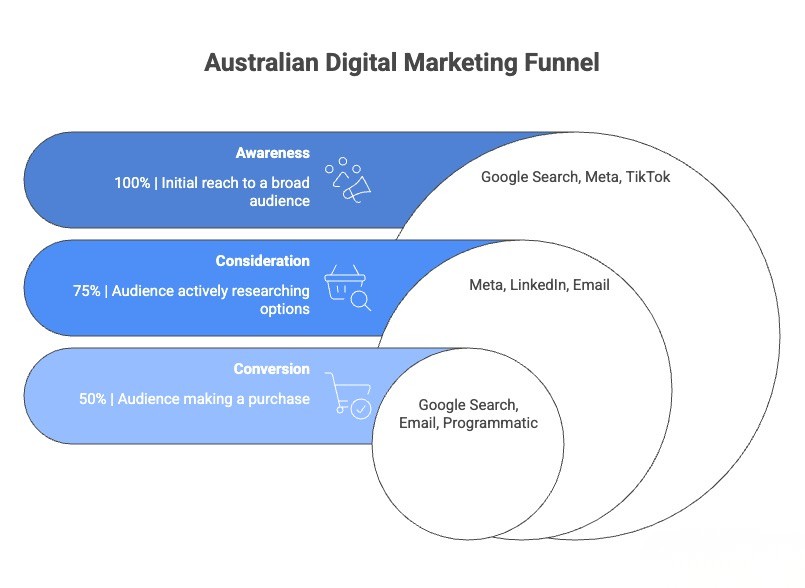
Google remains the dominant search engine with approximately 94% market share — a figure that has remained remarkably stable even as alternative platforms have grown. This means SEO and Google Ads are non-negotiable channels for virtually any Australian business with an online presence. Meta platforms — Facebook and Instagram — continue to dominate social advertising, particularly for consumer-facing brands. LinkedIn drives B2B lead generation in financial services, professional services, and technology. TikTok has crossed from novelty to performance channel, particularly for brands targeting under-35 audiences in urban markets.
Geography matters more in Australia than many agencies acknowledge. Consumer behaviour in Sydney’s eastern suburbs is materially different from the Sunshine Coast, which is different again from regional South Australia. Campaigns built on national generalisations routinely underperform campaigns built on genuine local audience insight. This is one of the first things a quality agency should raise with you — not wait for you to ask.
On the compliance front, the Privacy Act 1988 and its ongoing review are reshaping how agencies can collect, use, and store consumer data. Cookie deprecation, signal loss in Meta and Google, and growing consumer awareness of data privacy are all changing the technical foundations of digital marketing. The agencies best positioned to deliver results in this environment are those who have invested in first-party data strategy, not those still relying on third-party tracking workarounds.
Market Value: What Is Digital Marketing Worth in Australia?
The scale of digital advertising in Australia makes the stakes of choosing the right agency very real. Total digital ad spend is estimated above $4.2 billion AUD annually, with sustained growth projected as television, print, and outdoor budgets continue their long migration to digital channels.
| $4.2B+ Digital ad spend estimated 2024 | 94% Google search share in Australia | 88% Smartphone penetration rate | 6,000+ Active digitalagencies in AU |
Search advertising commands the largest share of that spend, followed by social media, programmatic display, and video. But the raw size of the market also explains why so many agencies exist — and why quality varies so dramatically. When a category grows fast, it attracts both exceptional operators and those who learn the language without mastering the craft.
For individual businesses, what matters is not what the market spends in aggregate but what your budget can achieve with the right partner. A $5,000/month retainer with a focused, experienced team will consistently outperform a $15,000/month retainer with an agency that over-promises and under-resources your account. The 10 questions below are designed to help you tell the difference before you commit.
| MARKET REALITY : Over 60% of Australian SMBs report dissatisfaction with their current or most recent digital marketing agency, citing vague reporting, poor communication, and strategies that felt generic rather than tailored to their business. These are not random failures — they are predictable outcomes of not asking the right questions before signing. |
Digital Marketing Agencies in Australia: What the Landscape Looks Like
The Australian agency market sits across a wide spectrum. At one end are large, full-service agencies — some locally owned, some subsidiaries of global holding companies — that offer everything from brand strategy and creative production to media buying, SEO, and analytics. At the other end are solo operators and micro-agencies specialising deeply in a single channel: Google Ads, email marketing, TikTok content, or conversion rate optimisation.
Neither model is inherently superior. The right structure depends on where your business is, what you are trying to achieve, and how much marketing function you already have internally. A founder-led business with no in-house marketing team often benefits from a full-service partner that can act as an outsourced marketing department. A business with a strong internal team and an established brand may only need a specialist to manage paid search or organic social.
What the best agencies share across all sizes and specialisations is a commitment to clarity: clear on what they will and will not do, clear on how performance is measured, clear on who is doing the work, and clear on what success looks like. The agencies to avoid are those who are deliberately vague — because vagueness protects the agency, not the client.
| HOW TO SHORTLIST :Before you start asking agencies questions, ask yourself three things: What specific outcome do I need — leads, sales, brand awareness? What is my realistic monthly budget including ad spend? Do I need a generalist partner or a specialist in one channel? Your answers will immediately filter out agencies that are not a structural fit, saving you time on both sides. |
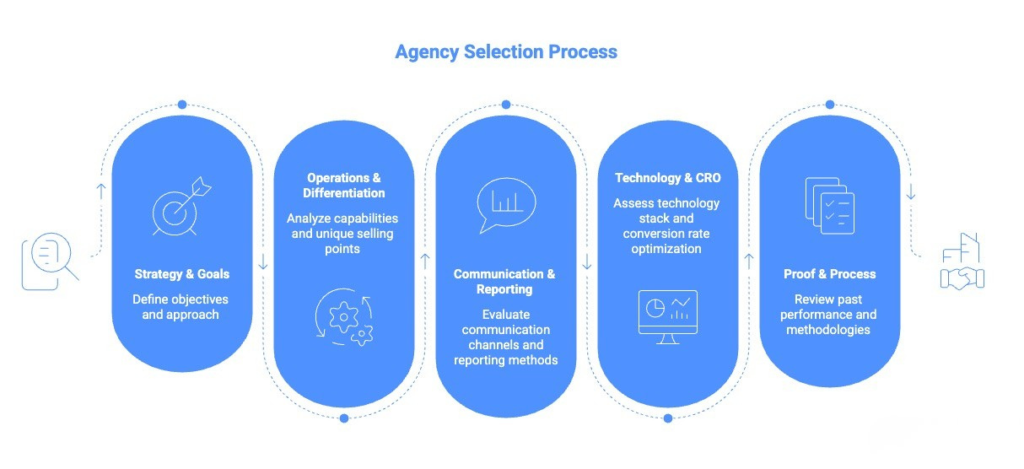
10 Important Questions to Ask Before You Hire a Digital Marketing Agency
These questions are not a checklist to race through. They are a conversation tool. The answers themselves matter — but so does the confidence, specificity, and honesty with which an agency responds. An agency that stumbles on question two has told you something important. An agency that answers every question with sharp, concrete detail, including acknowledging its own limitations, has earned your serious consideration.
Use these in your first or second meeting. Take notes. Compare answers across agencies. The differences will surprise you.
Q1 How do you differentiate our ads from every other business in our industry?
WHY THIS QUESTION MATTERS
Most industries in Australia are crowded with digital advertising. Whether you are selling home loans, running a dental practice, operating an e-commerce store, or offering professional services — your competitors are likely running ads on the same platforms, targeting the same audiences, and saying variations of the same things. The ad that wins is the one that earns attention before it earns the click. That requires a point of view, a creative angle, and a deliberate positioning decision. It does not happen automatically, and it does not come from a standard campaign template.
WHAT IT REVEALS ABOUT THE AGENCY
When you ask this question, you are really asking: does this agency have a process for building creative strategy, or do they just execute whatever the client provides? Agencies with genuine creative and strategic capability will immediately start asking about your customers, your competitors, and what makes your offer genuinely different. Agencies without it will talk about ad formats, targeting options, and platform features — which are tools, not strategy.
Push further by asking to see examples of campaigns they have run in competitive markets. Ask how they researched the competitive landscape before building creative. Ask whether differentiation is part of their onboarding process or an afterthought. The depth of their answer tells you whether creative strategy is a real capability or a talking point.
Q2 How will you achieve our specific business goals?
WHY THIS QUESTION MATTERS
There is a version of digital marketing that feels very busy but produces very little. Campaigns launch, dashboards fill with numbers, reports arrive on time — and meanwhile, the phone is not ringing any more than it did before. This happens when an agency optimises for platform metrics — clicks, impressions, engagement rates — without ever building a clear bridge between those metrics and the actual outcomes your business needs. Revenue, qualified leads, booked appointments, product sales: these are business goals. Reach and frequency are not.
WHAT IT REVEALS ABOUT THE AGENCY
This question tests whether the agency thinks in terms of your business model or in terms of their own deliverables. A strong answer starts with clarifying questions: What does a good month look like for your business? What is your average customer worth? What does your current conversion rate look like? Where in the funnel are you losing people? Agencies that skip these questions and go straight to tactical recommendations are telling you they plan to optimise for what they can measure easily, not what actually drives your growth.
The best agencies build a model — even a rough one — connecting their activities to your outcomes. They will say something like: if we drive 500 qualified visitors to your service page at a 4% conversion rate, that is 20 leads. At your current close rate of 30%, that is 6 new customers. Is that the kind of growth you are targeting, and does it justify this budget? That kind of thinking is rare. When you find it, pay attention.
Q3 How do you manage budget fluctuations?
WHY THIS QUESTION MATTERS
Digital advertising costs are not fixed. They move in response to seasonality, competitive pressure, auction dynamics, platform algorithm updates, and macroeconomic conditions. A Google Ads campaign that delivers a $12 cost-per-lead in February might cost $22 per lead in April when competitors increase spend ahead of a peak season. Meta CPMs spike during major retail periods like Black Friday and Christmas. These fluctuations are normal — but how an agency responds to them is not uniform.
WHAT IT REVEALS ABOUT THE AGENCY
Some agencies monitor pacing and performance weekly, catch cost increases early, and either shift budget to better-performing channels or adjust creative to maintain efficiency. Others set campaigns live and check in at the end of the month, by which point the budget has been spent and the damage is done. Asking this question up front tells you which kind of agency you are dealing with.
Listen for specifics: how often do they review budget pacing? What thresholds trigger a change in strategy? Do they have a process for reallocating budget between channels when one is underperforming? Do they communicate proactively when costs are rising, or retroactively after the month closes? An agency with a real answer to this question has been through enough campaigns to have developed a process. One without a real answer is still figuring it out.
Q4 What makes you different from other digital marketing agencies?
WHY THIS QUESTION MATTERS
This is the question agencies should be best prepared for — and yet it is the one where mediocre agencies most reliably reveal themselves. The tell is not a bad answer. The tell is a generic one. If an agency responds with phrases like results-driven, passionate about your success, or we treat every client like family, they have just told you that they have not thought seriously about their own positioning. Which raises an uncomfortable question: if they cannot differentiate themselves, how are they going to differentiate you?
WHAT IT REVEALS ABOUT THE AGENCY
The best agencies have a genuine, specific answer to this question. It could be industry specialization, where the agency focuses only on healthcare businesses and understands patient acquisition, compliance requirements, and content limitations. Additionally, it may involve a unique creative testing methodology or a team structure that ensures senior experts manage every account. In some cases, agencies also differentiate themselves through performance-based pricing models that align their fees with campaign results. Whatever it is, it should be something that matters to you and something that can be verified.
A particularly good sign: when an agency is willing to tell you who they are NOT right for. That kind of honesty requires confidence. It means they know who they serve well and are not trying to win every pitch. Agencies that will say yes to any client and any brief are agencies that spread themselves thin and personalise nothing.
Q5 How will you maintain communication with us?
WHY THIS QUESTION MATTERS
The agency relationship breaks down more often on communication than on performance. The pattern is predictable: during the pitch, you speak with a senior strategist who impresses you with their knowledge and attention. After signing, you are introduced to your account manager — who is often junior, often overloaded with accounts, and often not empowered to make strategic decisions. Emails take days. Questions go unanswered. By the time you realise the relationship has deteriorated, you are three months into a six-month contract.
WHAT IT REVEALS ABOUT THE AGENCY
Asking this question before signing forces the agency to commit to a communication structure that you can hold them to. You want specifics, not sentiment. Who exactly will manage your account and what is their experience level? Is there a standing weekly or fortnightly call, or only monthly check-ins? What is the expected response time for emails or messages? If your account manager is sick or leaves, what is the handover process? How do you raise concerns if something is not working?
The answer also tells you something about how the agency is structured internally. Agencies with too many clients per account manager cannot maintain genuine communication with any of them. Agencies that build account management into their model — with clear ownership, seniority, and communication schedules — create the conditions for the relationship to work.
Q6 How do you track and maintain records of all KPIs?
WHY THIS QUESTION MATTERS
A KPI is only useful if it is agreed upon in advance, measured consistently, and reported honestly. The problem with many agency reports is that they are designed to look good rather than to be useful. They are full of metrics that improved — click-through rate up, impressions up, engagement up — while quietly omitting the metrics that matter most, like cost-per-lead, cost-per-acquisition, and return on ad spend. A report that only shows green arrows is not a performance report. It is a marketing document.
WHAT IT REVEALS ABOUT THE AGENCY
What you need is a reporting structure where the metrics are agreed before the campaign launches, not after. Those metrics should connect directly to your business goals — not to what the platform dashboard makes easy to export. You also need honest commentary: what worked, what did not, what is being changed as a result, and what the next period looks like. An agency that only reports when things are going well and goes quiet when things are not has broken the fundamental trust the relationship depends on.
Request a real client report (with confidential details removed) to understand the agency’s reporting quality and transparency. Additionally, ask which tools they use, such as GA4, Looker Studio, or a proprietary dashboard. You should also understand how they manage attribution, especially the difference between last-click metrics and actual business performance. Finally, ask what happens to your data and account access if the partnership ends. These questions are not aggressive; instead, they are an important part of proper due diligence.
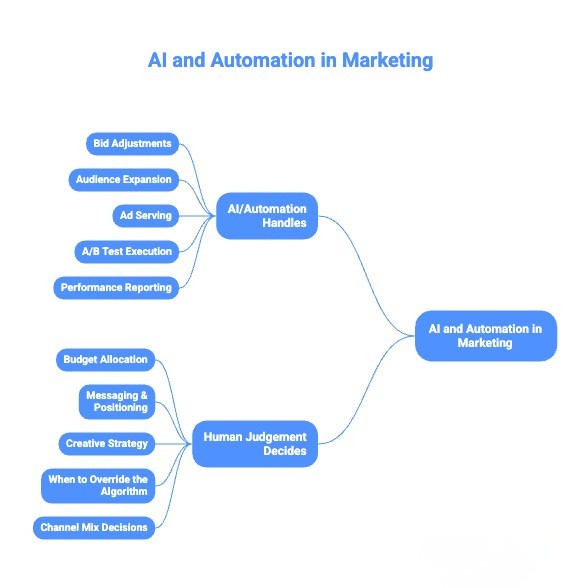
Q7 How do you approach AI and automation in campaign management — and where does human judgement come in?
WHY THIS QUESTION MATTERS
Automation has fundamentally changed digital advertising. Google’s Performance Max, Meta’s Advantage+ shopping campaigns, and smart bidding strategies now handle functions that previously required constant manual intervention. Used well, these tools accelerate performance. Used poorly — or handed over entirely without oversight — they can quietly drain budget on the wrong audiences, wrong placements, and wrong objectives for weeks before anyone notices.
WHAT IT REVEALS ABOUT THE AGENCY
The agencies that navigate this well have a clear philosophy: automation handles the execution of strategy, not the strategy itself. They set tightly defined parameters — target CPA ranges, audience exclusions, creative guardrails — and then let the algorithm optimise within those boundaries. The audit algorithmic decisions regularly rather than accepting platform recommendations at face value. They know when to override automated bidding and when to trust it. They use AI-assisted tools for creative testing and audience modelling but apply human judgement to the conclusions.
The agencies to be wary of are those at either extreme. Agencies that reject automation entirely are leaving performance on the table and working harder than necessary. Agencies that hand everything to the algorithm and call it AI-powered campaign management are, in practice, doing very little beyond initial setup. The question is not whether they use AI — it is whether a human being with genuine expertise is making the strategic decisions that automation cannot make.
Q8 What is your approach to the post-click experience?
WHY THIS QUESTION MATTERS
Here is a truth that many agencies would rather not dwell on: the ad is the beginning of the story, not the end of it. You can have the best targeting, the most compelling creative, and a perfectly optimised bidding strategy — and still lose every conversion because the page someone lands on after clicking is slow, confusing, inconsistent with the ad that brought them there, or simply not persuasive. The post-click experience is where advertising spend becomes business outcome, or does not.
WHAT IT REVEALS ABOUT THE AGENCY
An agency that measures success only in clicks is an agency that is not accountable for your actual results. Clicks are easy to generate. Conversions — real enquiries, real purchases, real sign-ups — require the full journey to be optimised. This means landing pages that load in under three seconds, messaging that directly continues the promise made in the ad, a clear and low-friction call to action, and social proof that addresses the specific hesitation your buyer has at the point of decision.
When you ask this question, you are finding out whether the agency sees itself as a media buyer or as a growth partner. A media buyer gets paid to place ads. A growth partner gets paid to drive outcomes — and understands that outcomes are produced by the entire customer journey, not just the top of it. Ask whether they offer landing page audits or builds. Ask whether they test landing page variations alongside ad creative and whether their reporting includes conversion rate, not just click rate.
Q9 What does the first 30 days of onboarding look like?
WHY THIS QUESTION MATTERS
The first 30 days are when the foundation is built. What gets established in this period — the tracking architecture, the audience understanding, the campaign structure, the communication rhythm — shapes everything that follows. A rushed or shallow onboarding produces campaigns that are technically live but strategically hollow. They run, they spend, but they are optimised for the wrong things from day one because the right things were never properly understood.
WHAT IT REVEALS ABOUT THE AGENCY
A structured onboarding covers five things: deep discovery into your business, customers, and competitive environment; full audit of any existing accounts, analytics, and historical data; technical setup of tracking, pixels, and conversion events; campaign architecture and creative planning; and a clear timeline with milestones for when each phase completes and when campaigns go live. None of this should be a surprise to a capable agency — it should be documented, structured, and presented to you at the start.
Two failure modes to watch for. The first is the agency that rushes to launch campaigns in week one before understanding your business properly. Speed feels impressive but it signals that they are following a template rather than building a strategy for you. The second is the agency that spends three months in discovery and planning without activating anything. Extended pre-launch periods often mask a lack of urgency or over-engineering of what should be a practical process. A well-run onboarding takes two to four weeks and produces active, intelligently structured campaigns.
Q10 Can you share case studies or proven results from businesses similar to ours?
WHY THIS QUESTION MATTERS
Every agency will tell you they deliver results. This is not a differentiator — it is the minimum expectation. What separates credible agencies from aspirational ones is evidence: specific, documented, verifiable results from real clients in real industries with real budgets. A case study that says we increased engagement for a lifestyle brand is not evidence. A case study that says we reduced cost-per-lead by 41% for a Sydney-based mortgage broker over a six-month period, with the methodology and metrics to back it up — that is evidence.
WHAT IT REVEALS ABOUT THE AGENCY
Ask for case studies that are relevant to your situation: same industry, similar business model, comparable budget, or the same primary goal — whether that is lead generation, e-commerce revenue, or brand awareness. Generic case studies from unrelated industries are better than nothing but are limited in what they tell you about the agency’s ability to perform in your specific context. Industry-specific experience matters because customer behaviour, competitive dynamics, compliance requirements, and conversion economics all vary significantly across sectors.
The most valuable option — if the agency is willing — is to speak directly with a current or former client. A brief reference call, even 15 minutes, reveals things that no case study can: how the agency communicates when things are not going well, how responsive they are to concerns, whether the client feels genuinely valued or like one of many. Agencies that actively facilitate reference calls are confident in their client relationships. Agencies that deflect or offer only written testimonials may have good reasons for doing so.
Agency Warning Signs You Should Never Ignore
Even with the right questions asked, certain answers or behaviours should end the conversation regardless of how good the pitch looked on paper:
| RED FLAGS TO WATCH : They guarantee specific Google rankings or ROAS numbers before reviewing any of your data. They cannot name the specific person who will manage your account day to day. Their reporting dashboard shows only vanity metrics with no revenue or conversion data. They push for a long-term contract with no performance clause or exit provision. They outsource creative, strategy, or account management offshore without disclosing it. They become evasive when asked about data ownership or what happens to your accounts if you leave. They answer every question with confidence but no specifics. |
Your Pre-Signing Checklist
Before you sign with any digital marketing agency in Australia, work through this checklist:
- You have asked all 10 questions above and received specific, substantive answers — not generalities or deflections
- You have reviewed at least two case studies relevant to your industry, goals, or budget level
- You know exactly who will manage your account, their seniority, and their experience in your sector
- You understand how KPIs will be defined, tracked, attributed, and reported — and on what schedule
- You have read the full contract including IP ownership, data ownership, notice periods, and any lock-in terms
- You have confirmed their approach to Australian privacy compliance and data handling
- Where possible, you have spoken with a current or former client of the agency directly
- You are confident this agency understands your market, your customers, and your commercial goals — not just your ad accounts
| FINAL THOUGHT :The agency that wins your business should not be the one with the most impressive deck or the most confident pitch. It should be the one that asked you the best questions, listened carefully to your answers, and then explained — specifically and credibly — how they would help your business grow. That combination of curiosity, expertise, and clarity is what great agency relationships are built on. |
Conclusion
Choosing a digital marketing agency in Australia is a decision that deserves more rigour than most businesses apply to it. The market is large, the options are numerous, and the quality gap between the best and the rest is enormous. The cost of getting it wrong — in wasted spend, lost time, and missed growth — is real.
The 10 questions in this guide are your filter. They are designed to surface what agencies will not volunteer: how they actually operate, who will actually do your work, how they will actually measure your results, and whether they genuinely understand your market or are applying the same template they use for every client.
Ask them in every meeting. Push for specific answers. Compare responses across agencies. The right partner will not just answer the questions well — they will make you feel like you found someone who genuinely understands the problem you are trying to solve.