
A B2B SaaS marketing manager in Bengaluru runs her first LinkedIn Ads campaign. She builds a clean single image ad a sharp headline, strong visual, one CTA. It runs for three weeks. The CTR is decent. The CPL is acceptable. She calls it a win and moves on.
Six months later, a competitor launches a carousel ad campaign targeting the same audience. Five slides. Problem on slide one, insight on slide two, product on slide three, proof on slide four, CTA on slide five. The dwell time per impression is 25% higher. The prospects who reach slide five convert at nearly three times the rate. The competitor’s sales team starts closing deals she didn’t know she was losing.
This is not a hypothetical scenario. It describes exactly what happens when B2B marketers in India choose a format by instinct rather than by data. And the data in 2025 tells a more nuanced story than most marketers expect.
The question carousel ads or single image ads does not have a single right answer. It has a right answer for each specific situation. This guide gives you the data, the logic, and the decision framework to find yours.
If you are new to LinkedIn Ads, read our guide on LinkedIn ads for B2B in India before going further. For a comparison of lead capture methods, our blog on LinkedIn Lead Gen Forms vs landing pages covers conversion mechanics in depth. And if your current campaigns are underperforming, see why your LinkedIn ads are not working for a quick diagnostic.
How to Choose the Right LinkedIn Ad Format
Choosing the right LinkedIn ad format comes down to understanding your goals, your message, your audience, and the resources you have available. Each format has its strengths, so the more closely you match the format to what you’re trying to achieve, the better your results will be. Here is a simple way to break down the decision-making process.
- Step 1: Identify your campaign objective
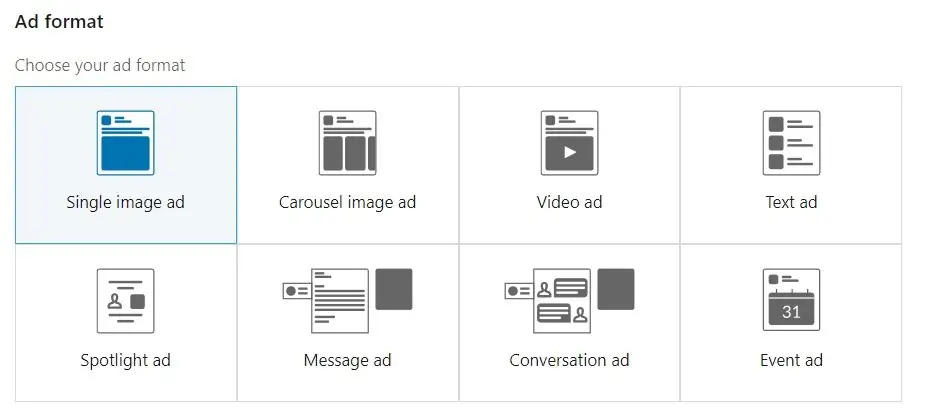
- If your objective is awareness, choose single-image ads.
- If you are trying to achieve consideration, use video, carousel, or sponsored messaging ads.
- If your goal is to drive conversations, use lead-generation forms or dynamic ads.
- Step 2: Consider the complexity of your message
- For simple ideas, image or text ads will work.
- For multi-layer stories, use carousels or video ads.
- If you have a personalized pitch, sponsored messaging, or dynamic ads are ideal.
- Step 3: Match the format to audience behavior
- If your audience is in research mode, carousel ads or video ads help provide more depth.
- If users are ready to download content or sign up, lead gen forms offer a frictionless experience.
- If your audience is casually browsing, single images or text ads work well for quick engagement.
- Step 4: Think about your creative resources
- If you have limited time or design support, single-image ads are easier to produce.
- If you have access to a designer or video editor, carousel ads or video ads allow for richer storytelling.
- Step 5: Test, measure, and adjust
- It’s important to run A/B tests on visuals, copy, and formats to see what resonates.
- Comparing performance over time helps you refine your strategy.
- Letting data guide your decisions ensures long-term success.
What the 2025 data actually says
Let’s put the numbers side by side. This data is drawn from multiple 2025–2026 benchmark reports covering hundreds of millions of LinkedIn ad impressions across B2B campaigns.
| Metric | Carousel ads | Single image ads |
|---|---|---|
| Average CTR (blended) | 0.32–0.49% | 0.42–0.61% |
| Engagement rate | 6.60% (highest of all formats) | 2–3% |
| Dwell time per impression | 4.56 seconds | 3.64 seconds |
| CPM (cost per 1,000 impressions) | ₹2,200–3,500 (lower) | ₹2,800–4,000 (higher) |
| Card 7 CTR (engaged viewers) | 2.89% | N/A single interaction |
| Best use case | Education, multi-feature, ABM | Single offer, cold audiences, simple CTA |
| Self-qualification mechanic | Yes every swipe filters intent | No single decision moment |
| Production time | Higher multiple slides | Lower one creative asset |
The most important number in that table is the Card 7 CTR of 2.89%. This is not the average CTR across all impressions it is the CTR of the users who were engaged enough to swipe through six cards before clicking. Those users are not casual scrollers. They are self-qualified prospects who have already absorbed your message across multiple touch points within a single ad unit.
Single image ads, by contrast, produce their clicks from a single moment of decision. The creative either works in that instant or it does not. There is no mechanism for progressive engagement. The prospect either clicks immediately or is gone.
The India context: what changes for Indian B2B advertisers
Mobile-first consumption
The majority of LinkedIn users in India access the platform on mobile. Carousel ads on mobile create a swipeable, thumb-friendly experience that feels native to how Indian professionals browse content. Single image ads on mobile occupy less screen space and compete with more feed content simultaneously. For mobile-heavy audiences in India’s Tier 1 and Tier 2 cities, carousel ads are structurally better suited to the consumption environment.
Complex products require multiple touchpoints
India’s most active LinkedIn B2B verticals SaaS, IT services, compliance tools, BFSI, HR tech, and manufacturing solutions all share a common characteristic: the product is difficult to explain in a single image. These are multi-stakeholder decisions with long evaluation cycles. Carousel ads give Indian B2B advertisers the space to address multiple objections, serve multiple stakeholders, and build the case across slides within a single ad impression.
The India CPM advantage
LinkedIn CPMs for Indian audiences are significantly lower than global averages roughly 40–60% lower than equivalent US-targeted campaigns. Carousel ads already deliver a lower CPM than single image ads globally. In India, this cost advantage is compounded. You are paying less per impression and getting more dwell time per impression. The economics of carousel advertising in India are materially better than the global benchmarks suggest.
Retargeting opportunity is underused
Carousel ads perform approximately 30% better for retargeting than for cold audiences. In India’s growing B2B digital ecosystem, most advertisers are still running primary acquisition campaigns and underinvesting in retargeting. This creates a disproportionate opportunity: a well-structured carousel retargeting campaign targeting website visitors, LinkedIn engagers, or video viewers will consistently outperform a cold-audience campaign at a fraction of the CPL.
Which format to use: a decision framework
Use this table to choose the right format before briefing your creative team. The answer is not always obvious but this framework makes it consistent.
| Situation | Use this format | Reason |
|---|---|---|
| Cold audience, first impression | Single image | Less friction, faster trust signal |
| Retargeting warm audience | Carousel | 30% higher CTR vs cold, multiple angles for warm prospects |
| Simple content offer (report, webinar) | Single image | One message, one click no additional complexity needed |
| Complex B2B product, multiple stakeholders | Carousel | One card per stakeholder concern, sequential case-building |
| ABM campaign for named accounts | Carousel | 4.56s dwell time vs 3.64s message absorption matters in ABM |
| Rapid A/B testing of hooks and visuals | Single image | Faster production, more variants per budget cycle |
| Product education or onboarding | Carousel | Step-by-step narrative fits naturally across cards |
| Direct demo or trial CTA | Single image | Simple ask doesn’t need multi-card justification |
| Customer story or case study | Carousel | Before → Challenge → Solution → Result across 4 cards |
| Brand awareness to new market | Single image | One strong impression beats complex content for cold audience |
The bottom line
Carousel ads are not better than single image ads. Single image ads are not better than carousel ads. They are different tools built for different moments in the buyer’s journey and the Indian B2B marketers who use them correctly are not choosing between the two, they are using both in sequence.
The data is clear: carousel ads earn more engagement, more dwell time, and more progressive qualification from the audiences that matter most in B2B. Single image ads earn more clicks from cold audiences and convert simple offers more efficiently. The skill is knowing which situation calls for which tool.